
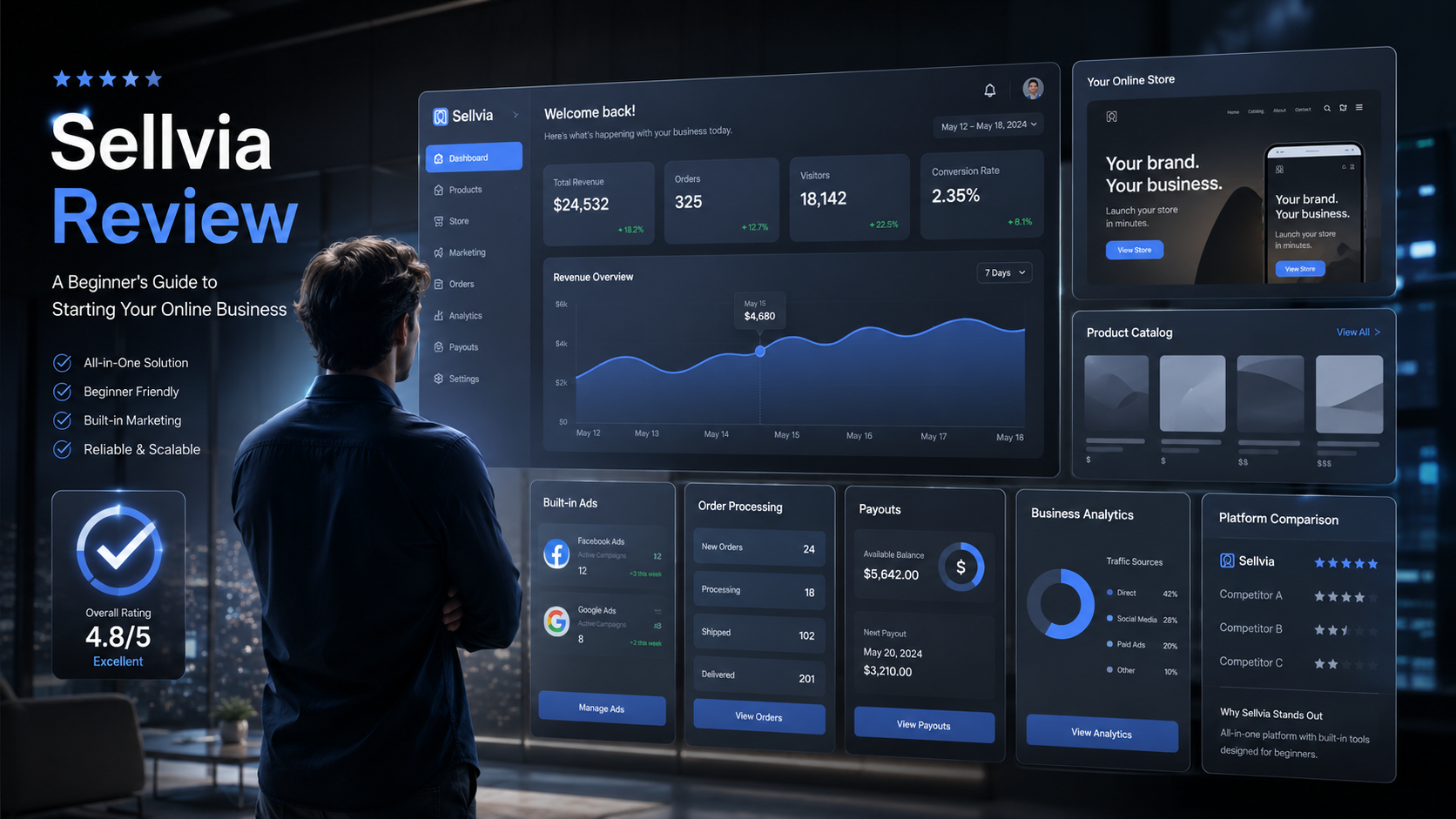
Sellvia Review
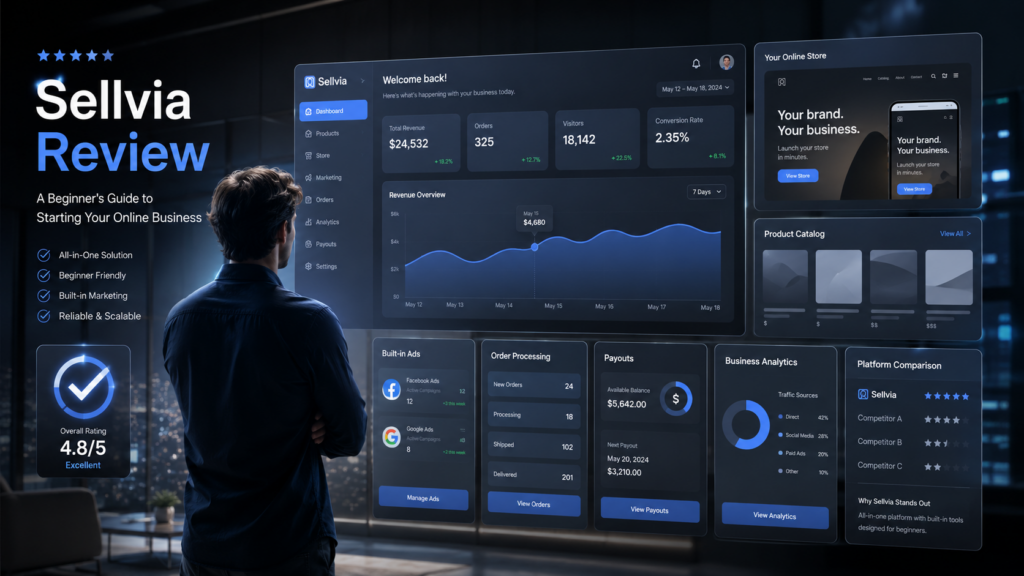
A useful Sellvia review should not stop at the question “is it good or bad?” It should explain what Sellvia actually gives users, how the business model works, what the platform helps with, and what a beginner should understand before starting. Many older reviews online still describe Sellvia using outdated dropshipping or physical-product language, which can be confusing for anyone researching the platform today. This review looks at Sellvia as it currently operates: a SaaS platform built around a ready-made store, a digital product catalog, built-in advertising, an order processing workflow, and a defined payout structure.
Looking for the main overview? Start with our Sellvia guide for pricing, tools, reviews, costs, and how the platform works.
Quick answer: Sellvia is a SaaS platform that gives beginners a ready-made online store, a digital product catalog, built-in advertising, an order processing workflow, and payout tools in one dashboard. It is not a passive income system, but for someone willing to treat it as a real business test with a realistic budget, it removes much of the setup work that normally slows beginners down.
What This Sellvia Review Is Based On
This Sellvia review focuses on the current digital-product version of the platform, including the ready-made store structure, product catalog, built-in ads, dashboard tools, order processing workflow, pricing layers, and payout expectations. It is written for beginners who want to understand how Sellvia works before deciding whether the platform fits their budget and goals.
Quick Verdict: Is Sellvia Worth It?
Sellvia is worth considering for beginners who want a structured way to start selling digital products online without building every piece manually from scratch. Its core value comes from combining store access, a product catalog, built-in advertising, dashboard tools, order management, and payout infrastructure inside one platform, instead of requiring users to assemble five or six separate tools on their own.
Sellvia is not a magic income button, and that is actually a positive signal. A platform that requires users to understand ad budgets, order processing, and payout timing is behaving like a real business tool rather than a get-rich-quick scheme.
| Category | Review Summary |
|---|---|
| Platform type | SaaS digital product business platform |
| Best for | Beginners who want a ready-made store and guided tools |
| Main advantage | Store, catalog, ads, dashboard, and payments in one place |
| Learning curve | Easier than building a digital product business manually |
| Main cost area | Monthly subscription plus advertising budget |
| Best mindset | Treat it as a real business test, not instant passive income |
| Overall review | Positive for beginners who want structure and simplicity |
For a deeper breakdown of costs, see Sellvia Pricing Explained and How Much Does Sellvia Cost?
What Is Sellvia?

Sellvia is a SaaS platform designed for people who want to start an online business selling digital products without prior technical experience. Instead of leaving users to build a website, source products, and figure out marketing on their own, Sellvia bundles these pieces into one system.
Inside the platform, users get:
- Access to a ready-made online store
- A digital product catalog they can add to their store
- A dashboard for managing orders, commissions, tools, and payouts
- Built-in advertising options that can generate traffic faster than waiting for organic search results
- A structured process for turning a new signup into an operating store
Most beginners run into the same set of problems when they try to start an online business alone: choosing products, building a store, setting up marketing, understanding how orders move through the system, connecting payment tools, and tracking basic business numbers. Sellvia’s role is to bring these separate pieces into one organized environment, which is the main reason it keeps coming up in searches related to Sellvia reviews and Sellvia for beginners.
How Sellvia Works in Practice
The general workflow looks like this:
- A user signs up for Sellvia
- The user gets access to the platform dashboard
- The user activates a ready-made digital product store
- Digital products are added from the catalog
- The user can turn on built-in advertising options
- Customers place orders through the store
- The user monitors and processes those orders through the dashboard
- Commissions and profit figures appear in the account
- Earnings move through the platform’s payout workflow
- The user requests a withdrawal once payout conditions are met
This is fundamentally different from starting with a blank website builder, manually creating every product, building ad campaigns without any prior structure, connecting separate payment tools, and designing a full order-to-payout workflow alone. Sellvia’s value is in reducing the number of separate systems a beginner needs to build from zero. For a full breakdown of this process, see How Does Sellvia Work?
What You Get Inside Sellvia
Ready-Made Digital Product Store
One of Sellvia’s clearest benefits is that users are not starting with an empty store. A ready-made structure lets beginners spend their early days learning the business model instead of spending weeks on setup and design decisions.
Digital Product Catalog
Sellvia’s catalog gives users access to digital products such as guides, courses, templates, checklists, ebooks, and other downloadable or online content. Because these are digital products rather than physical goods, users avoid many of the complications that come with shipping logistics or inventory management.
Sellvia Dashboard
The dashboard is the control center of the account. It shows orders, commission details, available tools, ad activity, payout status, and other business signals in one place, instead of forcing users to check multiple separate systems.
Built-In Advertising Options
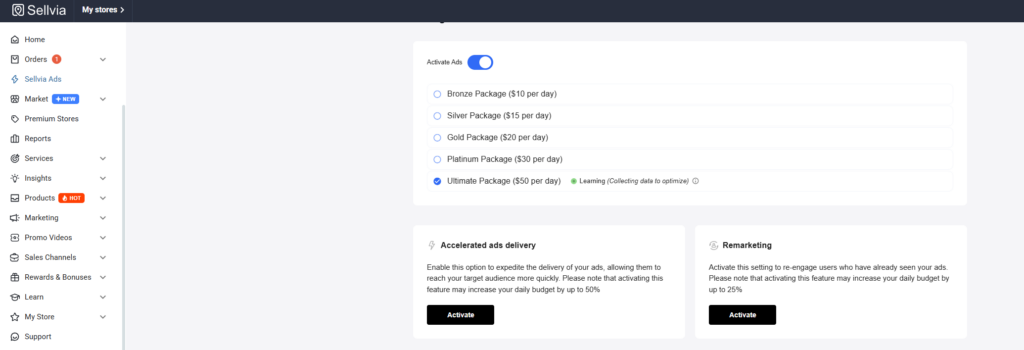
Sellvia Ads let beginners generate traffic without manually building every campaign from scratch. Since traffic is one of the hardest problems for anyone starting an online business, this is one of the platform’s most valuable features. See Sellvia Built-In Ads Explained for a full breakdown.
Order Processing Workflow
Rather than leaving order fulfillment as an unstructured task, Sellvia defines a clear order processing workflow inside the dashboard, so users know exactly what happens between a sale and a completed transaction.
Sellvia Payments and Payout Tools
Payout tools track earnings as they move through the account and help users understand when funds become available for withdrawal.
Support and Business Guidance
Beginner-oriented guidance helps new users understand platform features, next steps, and the overall business workflow, which matters most in the first weeks after signup.
Why Sellvia Is Helpful for Beginners
Beginners rarely fail because they lack motivation. They usually fail because they are trying to solve too many problems at the same time: building a store, choosing products, creating offers, setting up traffic, understanding payments, tracking costs, handling orders, and learning marketing basics, all before making a single sale.
Sellvia does not remove the need to learn the business, but it does remove a large amount of the early confusion by giving users a clearer starting structure.
| Beginner Problem | How Sellvia Helps |
|---|---|
| No store | Provides ready-made store access |
| No products | Gives access to a digital product catalog |
| No traffic plan | Offers built-in ads options |
| No order workflow | Provides dashboard-based order management |
| No payout structure | Includes payment and payout tools |
| No business system | Centralizes key tools in one platform |
Sellvia Pricing Review: What Users Should Understand
Sellvia pricing should be treated like a real business budget rather than a single fixed cost. The monthly subscription gives access to the platform, but a serious user also needs to think about advertising budget, order-related costs, and optional tools.
Rough cost layers to plan for:
- Base monthly subscription
- Advertising budget
- Order processing-related costs
- Optional performance tiers or upgrades
- Cash flow buffer while waiting for payouts
This is not unusual. Most online businesses require a platform cost plus a marketing budget. What makes Sellvia useful is that it makes these pieces visible inside one workflow instead of scattering them across separate tools. Pricing details and plan terms can change over time, so users should always confirm current numbers directly with Sellvia before budgeting. See Sellvia Startup Budget for a full planning breakdown.
Example 1: If the base subscription is around $39 per month and a beginner tests ads at roughly $10 per day, the advertising portion alone could add up to about $300 in a typical month. That means the realistic monthly testing budget is closer to the subscription plus that ad spend, not the subscription price alone.
Example 2: A user who wants faster data may choose to run ads more aggressively, which naturally raises the monthly figure. This is normal for paid traffic testing on any platform. The key metric to track is not total spend by itself, but cost per order compared with profit per order.
The main mistake beginners make is judging Sellvia only by the monthly fee. In reality, the better question is whether the platform gives enough structure to justify the full testing budget. For many beginners, that structure is exactly the point.
Sellvia Ads Review: A Major Advantage for Beginners

Traffic is usually the biggest obstacle for anyone starting an online store. Many beginners build a store, add products, and then realize no one is visiting it. Sellvia’s built-in advertising options matter because they give users a way to test traffic without starting completely from zero on ad platforms they have never used before.
Advantages of the built-in ads system:
- Easier to activate than manually building campaigns from scratch
- Useful for beginners with no prior advertising experience
- Integrated directly with the rest of the Sellvia workflow
- Helps users test product demand faster than relying on organic traffic alone
- Gives beginners a more practical route than waiting months for search engine traffic to build up
- Turns the platform into an active, testable business rather than a static store
Realistic expectations still apply. Ads require a real budget, results can vary between users and niches, and the first weeks should be treated as a testing period. Beginners should compare their ad spend against profit per order rather than assuming any fixed outcome. Sellvia Ads are valuable not because they guarantee profit, but because they give beginners a structured traffic mechanism, which is one of the hardest things to build alone.
Anyone who has tried running cold traffic on their own knows how steep that learning curve usually is. Getting a functioning ad account in front of real buyers on day one, instead of spending weeks fighting with targeting and creatives, is worth more than it sounds on paper.
Sellvia Product Catalog Review
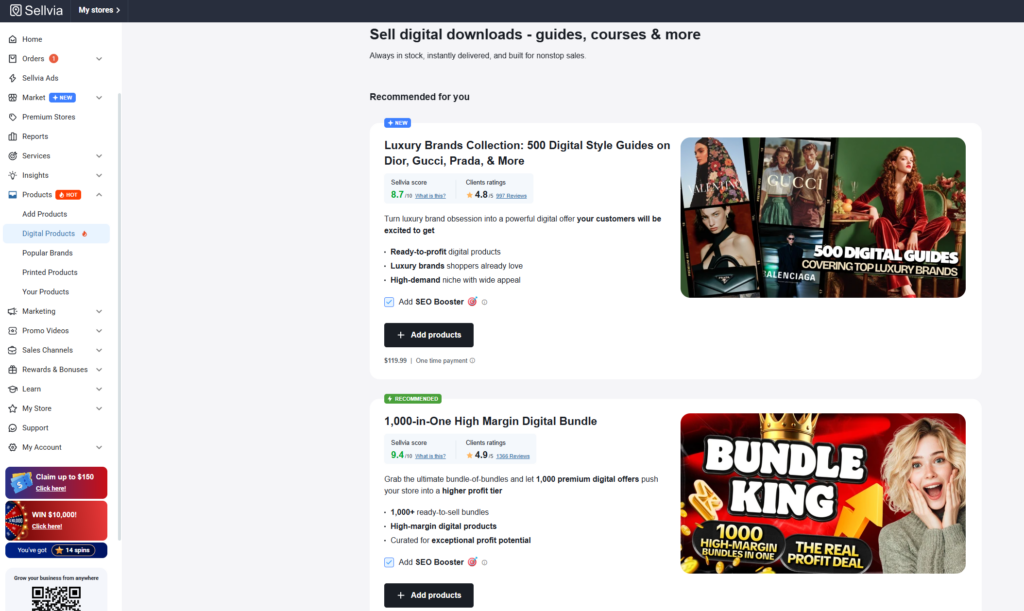
The digital product catalog is one of the platform’s strongest points. Typical categories include:
- Guides
- Courses
- Templates
- Checklists
- Ebooks
- Educational resources
- Business and lifestyle digital content
- Online learning materials
Because these are digital products rather than physical goods, the model avoids the operational weight of inventory, logistics, and fulfillment delays. Delivery happens digitally once an order is processed, which fits naturally into a SaaS-based business platform. For beginners, this matters because it removes the pressure of having to create every product manually before running a first test.
Sellvia Dashboard Review
The dashboard is where the business actually gets managed day to day. It typically shows:
- Orders
- Commission information
- Available tools
- Ad activity
- Account status
- Payout information
- Processing workflow status
- General business performance signals
Beginners need visibility more than anything else in the early stages. A single, clean dashboard helps users understand what is actually happening in their store instead of jumping between several disconnected systems, which is one of the more underrated parts of the platform.
Sellvia Order Processing Review
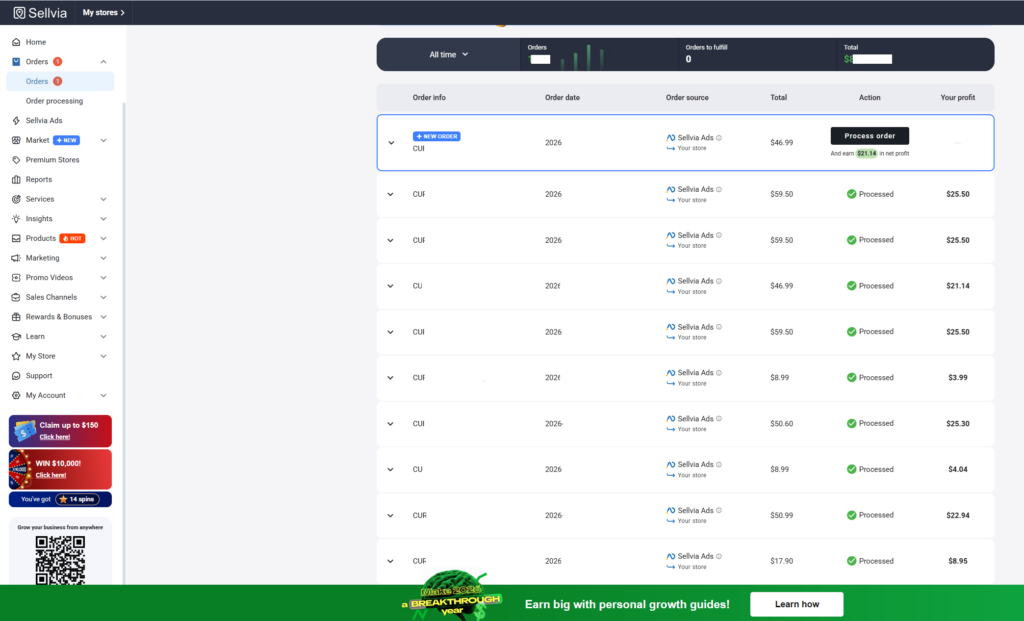
Order processing is not a weakness in the platform. It is simply part of how the business operates inside Sellvia, and serious users should understand how an order moves from sale to processing to payout before drawing conclusions about profitability.
The general order flow works like this:
- A customer places an order in the store
- The order appears in the dashboard
- The user follows the platform’s processing workflow
- The order is processed and the related fee is applied
- Profit or commission is tracked in the account
- The payout process follows the platform’s standard rules
Example: If a customer buys a digital product and the dashboard shows a profit figure for that sale, the user still needs to factor in the processing fee, any advertising cost tied to that sale, and payout timing before calculating true net profit. Looking only at the gross sale amount would overstate what the business actually earned.
Sellvia Payouts and Cash Flow
Sellvia uses a defined payout workflow rather than releasing funds the moment a sale happens. Earnings typically move through different balance stages before becoming available, for example a pending stage, then an incoming stage, before reaching an available-for-withdrawal stage. A short holding period, commonly around 72 hours, and a minimum withdrawal amount, often around $100, are the kind of details a serious user should confirm directly on the platform before planning cash flow.
This structure is not unusual. Many online platforms, payment processors, and marketplaces use similar staged-balance systems to manage risk and refunds. The practical point for beginners is simple: understand payout timing and thresholds before expecting funds to land in a bank account, and build a small cash flow buffer while waiting for the first payout cycle to complete.
Main Advantages of Sellvia
- Sellvia helps beginners start faster. Users are not required to build every part of the business manually before testing it.
- Ready-made store access. This removes a large share of the setup friction that normally slows new users down.
- Digital product catalog. Users do not need to create every product from scratch before making a first sale.
- Built-in ads options. Traffic is one of the hardest parts of online business, and Sellvia gives beginners a clearer starting point than building campaigns alone.
- Centralized dashboard. Orders, tools, payments, and performance data live in one place instead of several disconnected systems.
- Beginner-friendly structure. The platform is easier to understand than assembling separate store, product, and ad tools independently.
- Better starting point than a blank store. Many beginners lose months building a store with no products and no traffic plan in place.
- Useful for learning online business. Sellvia gives users a real framework for understanding traffic, orders, cost, and profit relationships.
- Digital-product model has operational advantages. No shipping, no physical inventory, and a cleaner fulfillment process overall.
- Good fit for users with a realistic budget. The platform works best when treated as a genuine business test rather than a shortcut.
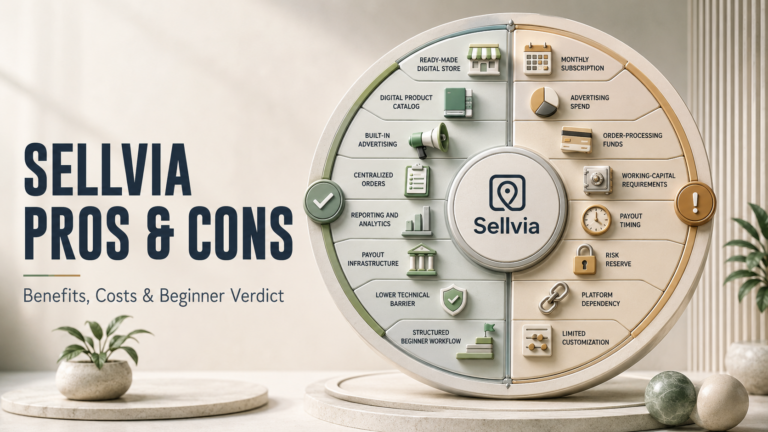
Things to Understand Before Using Sellvia
These points are not reasons to avoid Sellvia. They are the practical details that help users get more value out of the platform from day one.
- The monthly subscription is only one part of the total budget
- An advertising budget is needed to properly test the platform
- Results depend on traffic, product fit, offer quality, and consistency
- Payout timing should be understood before starting
- Order processing requires ongoing attention, not a one-time setup
- Sellvia is best suited to people who want structure rather than full manual control
- Tracking break-even math matters more than watching gross sales alone
- The platform should be treated as a business tool, not a passive income source
Who Sellvia Is Best For
Sellvia tends to be a strong fit for:
- Beginners who want a structured online business platform
- People interested specifically in selling digital products
- Users who do not want to build a store from zero
- People who want built-in advertising options instead of learning ad platforms from scratch
- Users who prefer a centralized dashboard over multiple disconnected tools
- Beginners who can set aside a realistic testing budget
- People who want to learn online business through a guided system
- Users who value speed and simplicity over full customization
Who May Not Be the Best Fit
Sellvia may not be the ideal match for:
- People who expect guaranteed profit
- People with no budget beyond the subscription itself
- People who are unwilling to test paid traffic
- People who want full, custom ownership of every technical detail
- People who do not want to monitor orders or dashboard activity regularly
- People looking for a completely passive system with no involvement
For the right user, none of these are major drawbacks. They simply confirm that Sellvia is best approached as a practical business platform rather than a shortcut to income with no effort involved.
Sellvia vs Building a Digital Product Store From Scratch
| Factor | Sellvia | Building From Scratch |
|---|---|---|
| Store setup | Ready-made structure available | Manual setup required |
| Products | Digital catalog access | Products must be created or sourced manually |
| Traffic | Built-in ads options | User must build a traffic system alone |
| Technical complexity | Lower | Higher |
| Speed to start | Faster | Slower |
| Dashboard | Centralized platform dashboard | Multiple separate tools may be needed |
| Payments and payouts | Platform workflow available | User must connect tools manually |
| Best for | Beginners wanting structure | Advanced users wanting full control |
Sellvia’s biggest advantage is not that it removes all effort from the process. It is that it gives beginners a much clearer and faster starting point than assembling a store, a product line, an ad system, and a payment workflow from separate tools.
Common Mistakes Beginners Make With Sellvia
- Treating the monthly subscription as the entire business budget
- Not setting aside a real advertising budget
- Expecting profit within the first days
- Ignoring payout rules and being surprised by timing
- Not reading the order processing requirements closely
- Confusing the current platform with older dropshipping-style descriptions
- Judging Sellvia only from outdated reviews rather than current information
- Not tracking break-even math
- Increasing ad spend without checking profit per order first
- Quitting before collecting enough testing data to draw a fair conclusion
Avoiding these mistakes tends to lead to a more accurate and fairer experience with the platform. It sounds obvious written out like this, but in practice, the users who quit early are almost always the ones who never wrote a single number down.
How to Evaluate Sellvia Before Joining
- Check the current subscription price directly on the platform
- Review trial terms carefully
- Confirm what is included in the base plan
- Check the available Sellvia Ads budget options
- Understand the order processing rules
- Understand the payout threshold and payout timing
- Read recent Sellvia reviews rather than older ones
- Decide on a realistic monthly testing budget
- Calculate how many sales are needed to break even
- Decide whether a ready-made platform or full DIY control fits better
A user who works through this checklist is far more likely to get real value out of Sellvia and use it as intended.
Realistic Sellvia Review: What Results Depend On
Sellvia gives users a strong structure, but outcomes still depend on several variables:
- Advertising budget
- Product fit for the target audience
- Conversion rate
- Average order value
- Processing-related costs
- Consistency over time
- How closely the dashboard is managed
- Time spent learning the system
- Ability to track numbers accurately
A simple break-even framework helps put this in perspective:
Total monthly cost = subscription + ads + optional tools + processing-related costs
Net profit per order = customer payment minus platform or order-related costs and advertising allocation
Break-even point = total monthly cost divided by net profit per order
Example 1 (cautious beginner): A user runs a small ad budget of around $10 per day, keeps the base subscription, and focuses on a narrow product niche. Their break-even point depends heavily on order volume, so early weeks are best used for testing and data collection rather than expecting immediate profit.
Example 2 (more active beginner): A user increases the ad budget to gather data faster, accepting a higher monthly cost in exchange for quicker insight into which products and offers convert. This approach can reach a clearer picture of profitability sooner, but it also requires a larger initial budget and closer monitoring of cost per order.
Neither example promises a specific result. They simply illustrate how the same platform can be tested at different budget levels, which is the fairest way to review Sellvia’s real earning potential.
Is Sellvia Legit?
Sellvia is a legitimate SaaS platform with a clear business model, dashboard tools, digital product access, advertising options, an order workflow, and payout infrastructure. The more useful question is not simply whether Sellvia is legit, but whether the platform fits a specific user’s budget, goals, and expectations. A platform can be entirely legitimate and still be a poor fit for someone who is not prepared to test traffic or track business numbers. For a deeper look at this question, see Is Sellvia Legit?
Sellvia Review Summary
| Review Area | Rating | Explanation |
|---|---|---|
| Ease of use | Strong | Beginner-friendly structure and centralized dashboard |
| Store setup | Strong | Ready-made store access reduces setup work |
| Product model | Strong | Digital products avoid many physical-product issues |
| Ads system | Strong | Built-in ads help beginners solve the traffic problem |
| Pricing clarity | Good | Users should understand subscription plus operating budget |
| Payout structure | Good | Clear platform workflow, but timing should be understood |
| Beginner fit | Strong | Best for users who want structure and simplicity |
| Overall verdict | Positive | Worth considering for beginners with realistic expectations |
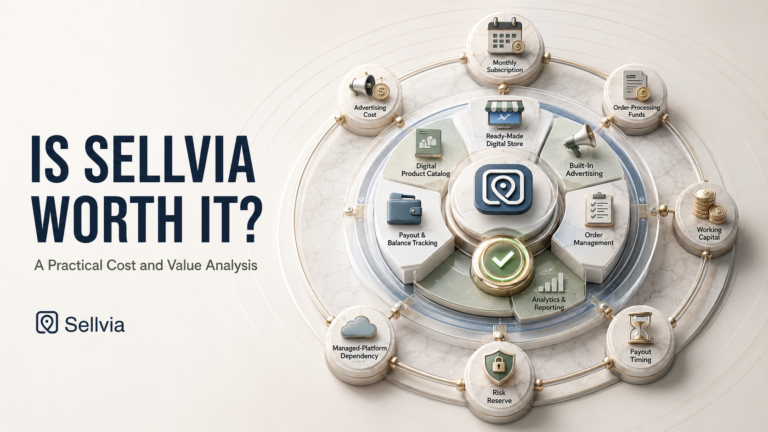
Final Verdict: Is Sellvia Worth It?
Sellvia is worth considering for beginners who want a ready-made digital product business setup instead of building everything from scratch. Its biggest value lies in combining store access, a digital product catalog, built-in ads, dashboard tools, order management, and payout infrastructure inside one platform.
Sellvia is not a magic income button, and that is part of what makes it more credible as a genuine business tool rather than a scheme. Beginners should start with a realistic budget, track ads, orders, and profit closely, and treat the first weeks as a real business test. For users who want structure, speed, and simplicity, Sellvia can be one of the more practical ways to begin testing an online digital product business.
Sellvia Review FAQ
What is Sellvia?
Sellvia is a SaaS platform that gives users access to a ready-made online store built for selling digital products such as guides, courses, templates, and checklists. Instead of requiring users to build a website, source products, and set up marketing separately, Sellvia combines these elements into one dashboard. Users can browse a digital product catalog, add items to their store, activate built-in advertising, and manage orders and payouts from a single account. This structure is aimed primarily at beginners who want a faster and simpler way to start an online business without prior technical or marketing experience.
Is Sellvia legit?
Based on available information, Sellvia operates as a legitimate SaaS platform with a defined business model, dashboard tools, a digital product catalog, an advertising system, an order processing workflow, and payout infrastructure. Legitimacy in this context means the platform has real, functioning systems behind it, not that every user will automatically profit. As with any business platform, results depend on the user’s budget, consistency, and product fit. Anyone evaluating Sellvia should look at current terms, pricing, and payout rules directly on the platform rather than relying only on older or unrelated reviews that may describe an outdated version of the service.
Is Sellvia focused on digital products?
Yes. Sellvia currently operates as a SaaS platform centered entirely on digital products rather than physical goods. There is no supplier sourcing, no shipping, and no warehouse involved in the current model. Users work with a digital product catalog that includes items such as guides, courses, and templates, which are delivered digitally once an order is processed. Some older reviews online still describe Sellvia using dropshipping or physical-product language, which reflects an outdated understanding of the platform rather than how it currently functions. This review focuses specifically on the SaaS, digital-product version of Sellvia.
How much does Sellvia cost?
Sellvia cost includes more than the base monthly subscription. Users should plan for the subscription itself, an advertising budget if they want to test the built-in ads system, and order processing-related costs tied to actual sales. For example, a small ad budget tested over a full month can add a meaningful amount on top of the subscription price. Because pricing and plan details can change, users should confirm current numbers directly on the Sellvia platform. A full breakdown of these cost layers is available in our guide on how much Sellvia costs.
Does Sellvia include advertising?
Yes. Sellvia includes a built-in advertising system that lets users generate traffic to their store without manually building campaigns from scratch on separate ad platforms. This is one of the most valuable parts of the service, since traffic is typically the hardest problem for beginners to solve on their own. Ad budgets are flexible and controlled by the user, and results depend on factors like product fit, offer quality, and consistency. Beginners should treat the early stage of running ads as a testing period, tracking cost per order against profit per order rather than expecting an immediate fixed result.
Can beginners use Sellvia?
Yes, Sellvia is specifically designed with beginners in mind. The ready-made store, digital product catalog, built-in advertising, and centralized dashboard are all meant to reduce the number of separate skills a new user needs before starting. Someone with no prior experience in web design, product sourcing, or digital marketing can still operate a store inside Sellvia’s structure. That said, beginners still need to learn some basics, such as how orders are processed, how payouts work, and how to read simple profit numbers. Sellvia simplifies the technical setup, but running the business still requires attention and consistency.
Can you make money with Sellvia?
It is possible to earn money with Sellvia, since users keep a share of the profit on processed orders, but no platform can guarantee income, and Sellvia is no exception. Actual results depend on variables such as advertising budget, product selection, conversion rates, and how consistently the user manages their store. Sellvia should be approached as a real business tool that requires testing and tracking, not as an automatic income source. Users who understand the cost layers, the order processing workflow, and payout timing are generally in a better position to evaluate whether their results are reasonable.
Is Sellvia worth it?
Sellvia is worth it for beginners who want a structured, ready-made way to test a digital product business without building every component manually. The combination of a store, product catalog, built-in ads, dashboard, and payout tools in one platform saves significant setup time compared with assembling these pieces separately. It is less likely to be worth it for someone expecting guaranteed profit with no budget beyond the subscription or no willingness to monitor their store. For a realistic, budget-aware beginner, this Sellvia review concludes that the platform offers a practical and reasonably priced starting point.

Jeck Palmer is an ecommerce writer and platform researcher at Sellvia.info. He specializes in analyzing Sellvia’s features, pricing, tools, advertising system, order workflow, and overall business model. His articles are designed to explain complex platform processes in clear and practical language, helping beginners understand potential costs, evaluate available tools, and make more informed decisions before starting an online business.
the payout staging section finally explained something that confused me for weeks. thought my money was stuck, turns out it just moves through pending to available like this describes
the break-even formula at the end is more useful than most sellvia review posts i’ve read. actually sat down and calculated my own numbers after reading this instead of just going by gut feeling
solid overview but i’d push back slightly on “not unusual” framing for the payout holding period. 72 hours plus a $100 minimum genuinely does hit differently when you’re just starting and your balance is small
fair point but that’s true of basically every payment platform with staged balances, not specific to sellvia. still annoying in month one though, agreed there
the “who may not be the best fit” section should be required reading before anyone signs up. wish someone had shown me this before i went in expecting fully passive results
appreciate that this actually separates the current digital product model from the old dropshipping description. still see people confusing the two in other threads
the common mistakes list nails it. quit way too early on my first attempt because i never actually tracked cost per order, just eyeballed the dashboard and panicked over a slow week
good breakdown of ads as a traffic solution rather than a profit guarantee. matches my experience – orders came fast once ads were on, profit took longer to actually show up net
been on the platform 5 months, this review is more balanced than most. the pricing section especially – too many people budget the subscription alone and get blindsided in month two exactly like this warns