
Best Sellvia Digital Product Niches: An Editorial Catalog Review
When we review a Sellvia store, our first question is not “Which category sounds profitable?” It is “What problem can this store explain and solve consistently?” That question changes how we look at niches. A focused shop built around a clear buyer need can present a handful of complementary digital products more convincingly than a large shop with no recognizable purpose.
This editorial shortlist comes from working through Sellvia’s digital-product formats and customer-facing storefront logic. We assessed the clarity of each niche, the kinds of resources that fit naturally together, how easy it is to explain an offer, and whether the category gives a store room to grow. The result is a practical selection guide, not a superficial list of trendy keywords.
The most interesting question about a large digital-product catalog is not how many categories it contains. It is whether a store owner can choose a category that feels purposeful to customers. A visitor deciding whether to purchase a printable planner, a learning resource, or an AI toolkit wants to know what problem the product will solve. The same logic should guide the entire storefront.
Sellvia’s published information describes digital resources in areas including wellness, productivity, home organization, and seasonal occasions. It also identifies formats such as guides, courses, templates, checklists, and AI-oriented toolkits. That combination creates room for different store concepts without requiring the operator to originate every file independently.
Our positive editorial view is that Sellvia’s ready-made digital catalog makes niche selection a practical curation exercise rather than a product-development project. The risk is selecting a niche only because it sounds popular, then publishing unrelated material that gives buyers no reason to trust the collection. The opportunity is to identify one real audience and build an offer around how that audience makes decisions.
What makes a niche suitable for digital products?
A good digital-product niche has four qualities. First, buyers encounter a repeatable problem. Second, that problem can be addressed through information, planning, or guided practice. Third, the results can be communicated honestly without promising an outcome outside the seller’s control. Fourth, there is room to offer complementary resources so the store does not depend on a single file.
The right niche is not always the broadest. ‘Wellness’ can describe a thousand unrelated interests. ‘Daily planning tools for people trying to build a consistent routine’ describes an understandable audience and purpose. The narrower framing is easier to translate into categories, homepage language, and useful content.
Productivity and personal organization: a practical starting point
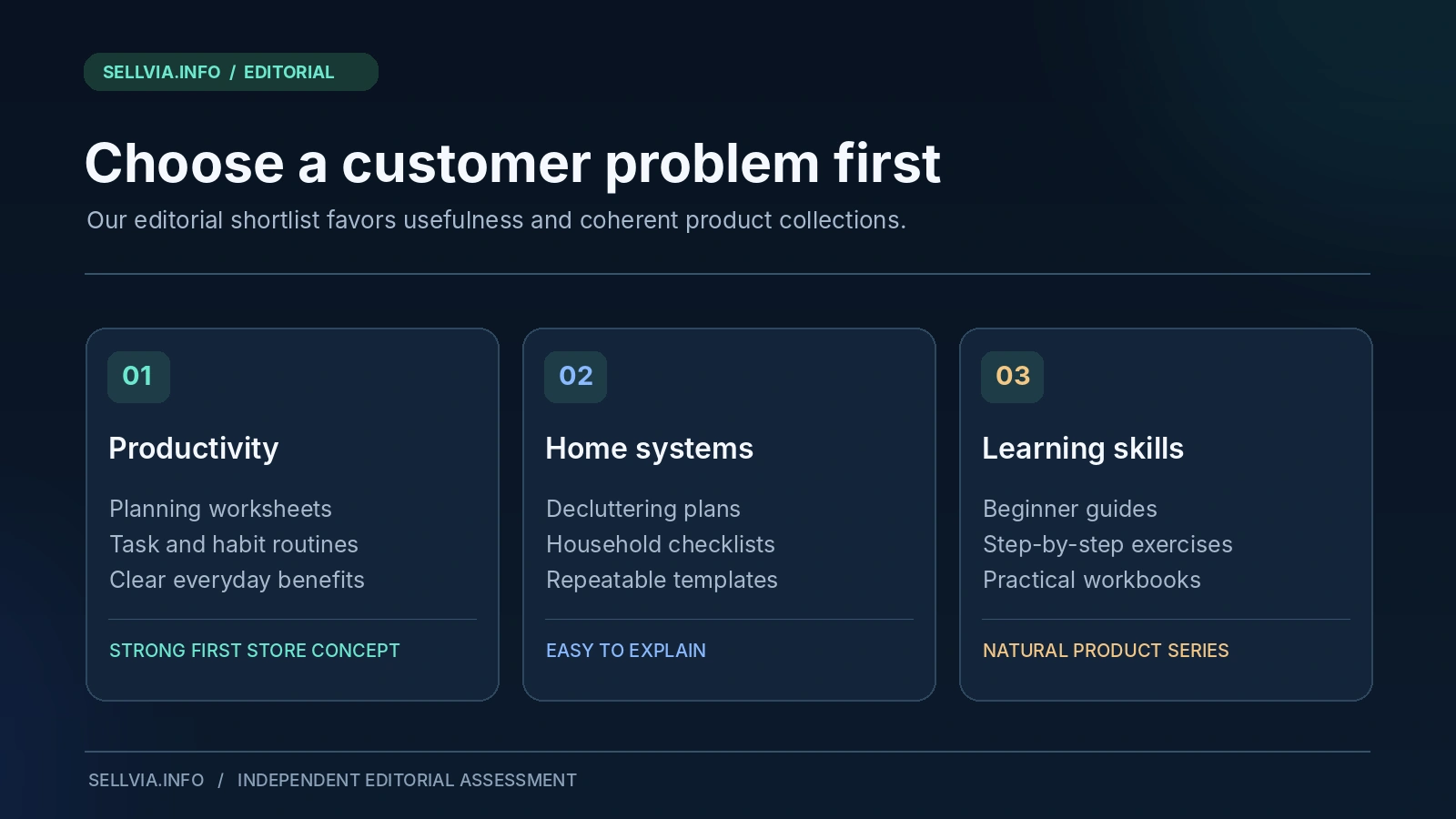
Productivity is an attractive digital niche because the tasks are familiar. People need to plan projects, manage recurring responsibilities, set priorities, or organize routines. A planner, checklist, worksheet, or short guide can address a discrete part of that process. The value proposition is concrete: make a task easier to structure and repeat.
A good store in this area would not promise that one purchase automatically transforms someone’s life. It would show how specific resources help the buyer prepare for a week, organize a project, or break an intimidating task into steps. That creates room for clear demonstrations and genuinely useful preview content.
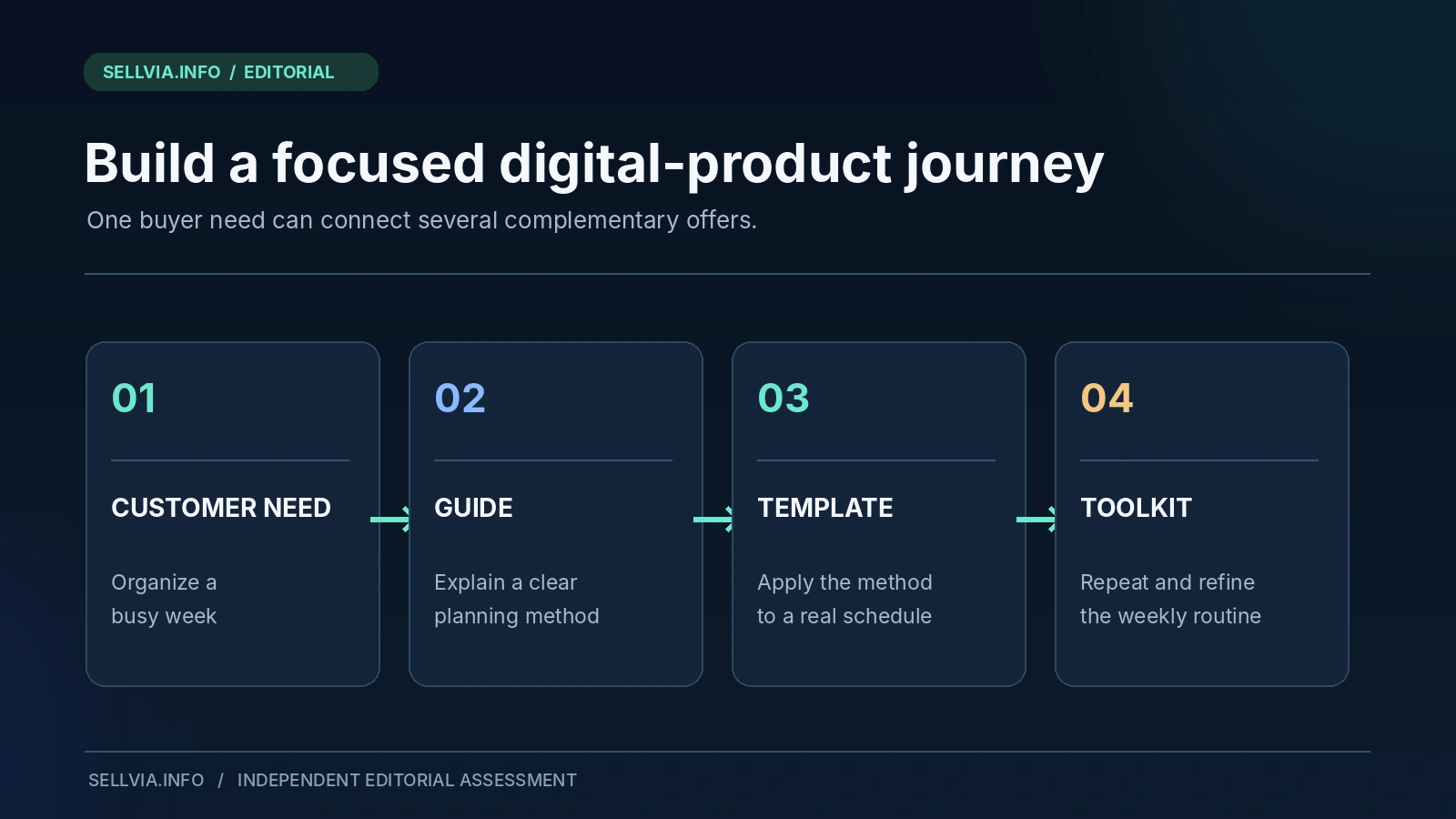
The niche also offers natural connections among product formats. A beginner’s planning guide explains the method. A weekly template provides a place to apply it. A checklist supports implementation. An AI-related prompt guide, if available and appropriate, could help users adapt a plan to their situation. These offerings share one customer purpose instead of competing for attention.
For a new operator, the editorial appeal is strong: outcomes can be discussed in terms of practical usefulness rather than speculative income claims. The owner can review layouts, readability, instructions, and topic fit before deciding which resources belong in the store.
Home organization: useful resources for everyday routines
Home organization is another niche that maps naturally to digital material. Planning routines, decluttering checklists, household schedules, seasonal preparation worksheets, and reference guides can turn complicated chores into manageable steps. Buyers often value immediate clarity more than technical sophistication.
A useful home-organization store would choose a narrow promise, such as helping households establish easy-to-maintain systems. Its products could address storage decisions, recurring maintenance, shared schedules, or one-time projects. The content strategy might include practical explanations of how to use a checklist or combine several worksheets into a monthly routine.
This category benefits from visual explanation. A simple editorial infographic can show a sequence, while a printable preview can show the form of the final resource. However, any imagery suggesting a finished outcome should be clearly illustrative unless it documents an actual customer example with permission.
Sellvia’s stated inclusion of home-organization materials is encouraging because the format matches the task. The store owner still needs to inspect the actual products and make sure they are neither repetitive nor too generic. The opportunity is strongest when the assortment helps a visitor move through a recognizable set of problems.
Wellness and self-care: valuable, with a higher accuracy standard
Wellness products can support journaling, reflection, routines, habit tracking, and general education. They often lend themselves to workbooks and checklists. That makes the niche appealing for digital resources intended to be used repeatedly rather than consumed once and forgotten.
It also creates extra responsibility. An educational guide should not claim to diagnose or treat a medical condition, guarantee symptom relief, or substitute for individual professional advice. Even when the tone is encouraging, the product page needs boundaries that reflect what the file can actually do.
A responsible wellness store could focus on everyday planning and personal organization: habit journals, non-clinical self-care worksheets, or routine-building resources. That is a more defensible position than a collection promising dramatic health results. The distinction protects readers and gives the site a clearer identity.
Our editorial assessment is positive about the format’s usefulness, not about clinical effects. Sellvia’s ready-made catalog can reduce preparation work for a seller entering the category, but health-related claims should receive more careful scrutiny than a general productivity checklist.
AI for everyday tasks: the niche that needs the clearest explanations
AI-related products attract interest because many people want practical guidance without learning technical terminology. The strongest digital resources translate a broad capability into a recognizable task: structuring a meeting agenda, brainstorming a project outline, reviewing a draft, or planning a recurring workflow.
The product should explain which part is a reusable document, which part requires a third-party AI service, and whether additional accounts or fees may be necessary. If it is a prompt-based guide, buyers need examples of both useful inputs and limitations. A resource that merely promises ‘AI-powered success’ is not a reliable editorial foundation.
For Sellvia, the described presence of AI toolkits alongside conventional educational formats creates an interesting merchandising opportunity. A store could pair a non-AI planning workbook with an optional AI-assisted companion workflow. That keeps the customer’s objective central instead of forcing every product into a technology-first explanation.
AI-related resources are especially interesting when they offer a concrete workflow. An editor can demonstrate how a worksheet is adapted or how a prompt becomes a usable planning tool, then explain the limitations of automated output. We prefer that grounded approach to vague promises about productivity. It is a natural way to turn Sellvia’s ready-made resources into a useful subject-focused store.
Learning and professional skills: focus on a defined outcome
Courses, guides, and templates are well suited to skills that can be developed through structured instruction. A career-related store could focus on meeting preparation, project communication, personal organization at work, or beginner professional routines. A creative-skills store could select guides and exercises around one accessible discipline.
A product collection might progress from an introductory guide to a worksheet and then to a deeper practice resource. That progression helps people choose based on current needs. It also gives the website a logical category structure and provides natural internal links between related pages.
From a merchandising perspective, the advantage is immediate: a store can arrange learning resources as an actual pathway, from basic explanation to practice and then to a reusable template. We favor clearly labeled skill levels and pages that say what a learner will do next. Sellvia’s ready-made product structure supports that style of presentation without forcing the owner to build a course collection first.
Seasonal and occasion-based planning: useful but not a whole strategy
Seasonal occasions offer clear customer moments: preparing an event, coordinating a celebration, organizing a personal project before a deadline, or planning a recurring annual activity. Digital checklists and planning resources can provide timely help with those tasks.
For example, a general organization store can feature an occasion-planning set when relevant, while keeping evergreen routines visible throughout the year. This creates a coherent reason for seasonal resources to appear rather than treating them as disconnected additions.
The advantage of Sellvia’s described catalog breadth is that an owner can potentially refresh thematic collections without rebuilding the entire site. The exact products and access conditions must be checked in the current store, but the editorial strategy is sound independently of any single seasonal trend.
How the niches compare for a beginner
We compare niches by how clearly they communicate a customer outcome, how naturally their products complement one another, and how much specialized accuracy is required. This is a more useful approach for a new digital-product store than copying a generic “most profitable niches” list. It also makes our recommendation reproducible: another editor can apply the same questions to a different assortment and reach a defensible conclusion.
| Niche direction | Buyer problem | Particularly suitable formats | Editorial caution |
|---|---|---|---|
| Productivity | Planning and follow-through | Workbooks, planners, checklists | Avoid promising guaranteed performance gains |
| Home organization | Managing everyday routines | Schedules, printables, guides | Demonstrate use, not perfect outcomes |
| Wellness | Reflection and healthy habits | Journals, habit worksheets, educational guides | Avoid unsupported health claims |
| Everyday AI | Applying AI to specific tasks | Prompt guides, templates, workflows | Explain third-party requirements and output limits |
| Professional learning | Building a defined skill | Courses, exercises, guides | State audience level and prerequisites |
| Seasonal planning | Preparing for occasions | Calendars, event guides, checklists | Balance time-sensitive offers with evergreen material |
For someone launching a first focused store, productivity and home organization are often easier to explain with practical examples. Wellness and AI can be strong when the editorial team is willing to review claims carefully. Skills and seasonal planning work best when the audience and use case are explicit. None of these judgments is a forecast of individual earnings.
A better niche-selection method than chasing trends
Begin with a sentence, not a product count: ‘This store helps [specific audience] accomplish [specific task] using [type of resource].’ If the sentence is vague, the niche probably needs refinement. A useful position might be ‘resources for busy professionals organizing their weekly priorities’ rather than ‘everything about personal development.’
Next, inspect the product choices actually available in your assigned Sellvia store. Shortlist resources that serve the same customer. Write down what each item is supposed to achieve and whether it adds a new step, a different format, or a distinct skill. Remove near-duplicates unless their differences are genuinely useful.
Then build a simple offer progression. The first product introduces the problem. The second gives the user a practical tool. A third offers more structured guidance. This is not a mandatory commercial funnel; it is a way to make categories understandable and avoid overwhelming visitors with many unrelated files.
Testing niche fit without inventing demand figures
Keyword tools and Search Console can eventually help measure which topics draw interest, but they should not be replaced by guesswork about search volumes. A useful initial evaluation can still be performed through qualitative checks: look for a clear buyer task, review competing explanations, and identify questions that existing product pages answer poorly.
Once the store receives actual visits, use its reporting tools to observe which pages attract interest and which paths visitors follow. Our Sellvia Reports Explained guide covers those reporting concepts. Do not interpret a high view count as proof of demand for a niche without also considering the source of traffic and the actions visitors take.
Why category design matters as much as niche choice
Aim for a small number of clearly differentiated categories first. Then examine whether each product belongs unambiguously in one place. If an item fits nowhere, it may be outside the store’s promise. If almost every item fits everywhere, the category labels may be too broad.
The existing Sellvia Product Catalog Explained guide discusses the difference between the source library and the customer-facing selection. This article takes that logic further: the niche is the editorial promise, and the category structure is how a visitor experiences it.
Why these niches made our editorial shortlist
The strongest Sellvia niches share a pattern: they translate an everyday problem into a resource the buyer can use. Planning and organization are particularly clear because the product itself can demonstrate a result: a schedule, a checklist, a reusable template, or a repeatable routine. A visitor should not need to understand the platform to recognize the value.
We also like the breadth of formats that Sellvia’s digital-product model can accommodate. A single theme can support a short guide for beginners, a more detailed workbook, and a toolkit for someone ready to apply the advice. That gives an editor several distinct product roles within one store rather than forcing every listing to compete for the same search query and customer need.
Our shortlist is deliberately based on buyer clarity, catalog coherence, and product-format fit. We check how easily a category can be described in one sentence, whether product pages would feel related, and whether the theme has a natural second purchase. These are criteria a store owner can apply immediately when reviewing a Sellvia catalog. A niche is not automatically attractive because an unrelated public marketplace shows a high list price or many reviews.
The practical conclusion is positive: Sellvia’s prepared digital-product setup makes it reasonable to test several coherent content directions without authoring a new collection from scratch. The smarter move is to select the clearest direction, build a thoughtful storefront around it, and use order and visitor reports to decide what deserves expansion.
A sample store concept: ‘Better Weekly Planning’
Imagine a storefront built for people who want an easier way to organize work and personal priorities. The homepage promises help with weekly planning, not a generic transformation. Its navigation leads to an introduction guide, a weekly template, a task-prioritization checklist, and perhaps an AI-assisted planning workflow if such a resource is available and suitable.
Each page makes a different contribution. The guide explains a method; the template supports use; the checklist helps review progress. A blog post about recovering from an interrupted week can link naturally to the guide without sounding like a generic advertisement. A second post might explain how to choose realistic priorities, offering practical value before presenting a relevant product.
Our editorial shortlist and final verdict
For a first digital-product store, our initial editorial shortlist favors productivity, home organization, and clearly defined learning tasks. Their needs are specific, their outputs are often easy to describe, and their resources can form an understandable progression. Wellness and practical AI also have promise when claims are reviewed carefully and the deliverables are explained clearly. Seasonal resources are useful as a supporting collection rather than an automatic substitute for an evergreen identity.
This is a favorable assessment of Sellvia’s niche flexibility. The platform’s documented catalog range creates room to choose an audience-led theme without first writing every course, guide, or worksheet. The opportunity is strongest when the seller resists the temptation to display everything and instead chooses a smaller collection with a recognizable purpose.
Our recommendation is not to chase a ‘most profitable Sellvia niche’ headline. Choose a group of customers whose needs you can explain accurately. Match that need to the formats you can actually inspect. Build useful category pages and independent content around the problem. The most convincing advantage of a prepared catalog is not speed alone; it is the ability to spend more attention on making the store intelligible and relevant.
Frequently asked questions
Which Sellvia digital-product niches are worth evaluating first?
Our editorial starting points are productivity, home organization, professional-learning resources, everyday AI workflows, and carefully framed wellness materials. Final selection should depend on the products available in your account and the audience you intend to serve.
Are these Sellvia’s official top-selling niches?
No. This is our editorial shortlist, based on audience clarity, coherent product ranges, and practical usefulness. “Best” describes the strength of the store concept, not an official Sellvia sales ranking.
Can I combine two niches in one store?
Yes, if they serve a recognizable common audience. For example, organization and productivity overlap naturally. Avoid combining unrelated themes only to increase the number of listings.
Do I need a very large catalog before launching?
Not necessarily. A smaller, clearly presented selection can make a stronger impression than a long assortment without a theme. Begin with products that serve different stages of the same problem.
Is the Sellvia Mall catalog identical to my store’s catalog?
Do not assume it is. Sellvia Mall identifies itself as a separate service. Verify the listings and permissions in the dashboard connected to your own store.
What should I measure after publishing niche content?
Look at real visitor activity, relevant product-page engagement, and meaningful order data using your available reporting system. Avoid making earnings claims based on category popularity or product-count estimates.
Editorial references: The niche recommendations are our original judgments based on Sellvia’s digital-product formats, current Terms of Use, and the store-selection criteria described above. The charts visualize our selection method rather than platform-reported category revenue.

Jeck Palmer is an ecommerce writer and platform researcher at Sellvia.info. He specializes in analyzing Sellvia’s features, pricing, tools, advertising system, order workflow, and overall business model. His articles are designed to explain complex platform processes in clear and practical language, helping beginners understand potential costs, evaluate available tools, and make more informed decisions before starting an online business.