
Sellvia Digital Products Review: A Closer Look at Catalog Quality
What separates a convincing digital-product store from an ordinary collection of thumbnails? After working through Sellvia’s product-selection and storefront workflow, we kept coming back to one answer: the quality of the buying decision. A prepared product page is valuable, but the real question is whether the buyer can understand the resource, know how to use it, and see why it belongs in the store.
Our editors assess Sellvia’s digital products from that practical perspective – first as someone curating a store, then as a buyer deciding whether a resource solves a specific problem. This is a positive review of a thoughtfully structured catalog, with close attention to the details that make a digital product genuinely useful.
A ready-made digital-product catalog solves an unusually practical problem: the work does not begin with inventing an entire line of products. Instead, the store owner can begin by choosing what belongs together, checking that the descriptions are accurate, and deciding how the offer should be presented to a particular audience. That shifts effort from production to selection and curation. Whether that shift produces a good store depends on the underlying materials.
Sellvia positions its ecosystem around a turnkey storefront and a catalog of digital resources. Its published materials identify guides, ebooks, courses, templates, checklists, and AI-related toolkits among the available formats. The platform says the digital materials are created by its team or covered by rights it holds. That is a clearer starting point than a marketplace where the source of each uploaded file is uncertain.
Our editorial verdict is positive for a specific reason: Sellvia gives a store owner a genuinely useful starting structure for presenting digital products. Prepared listings and a range of resource formats reduce the amount of basic catalog-building work. The strongest stores still apply editorial judgment, but they begin with something tangible rather than an empty editor and a vague idea.
What ‘catalog quality’ should mean
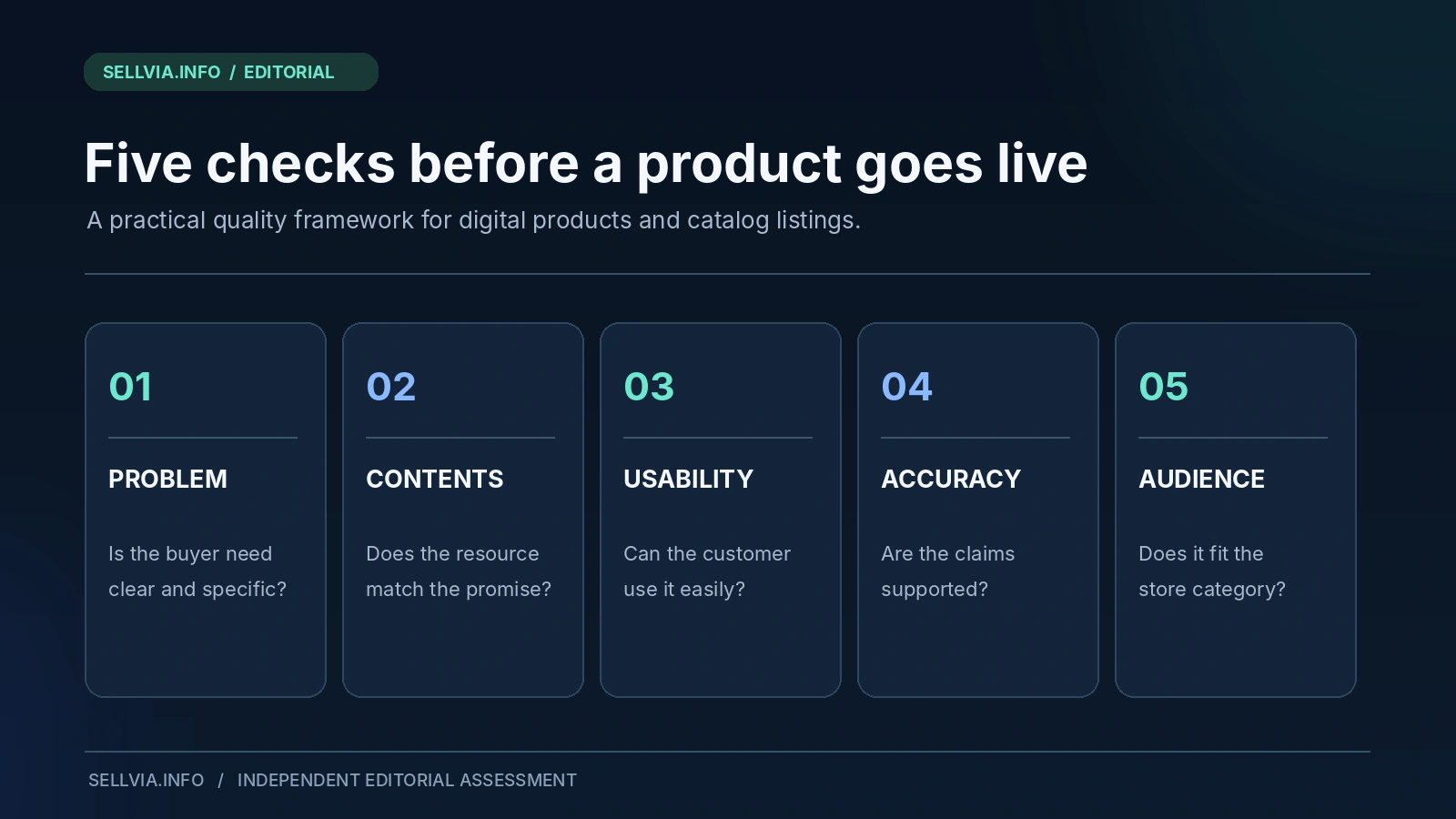
For this review, we use five editorial dimensions: clarity of the customer’s problem, specificity of the contents, practical usability, accuracy of the page’s claims, and fit within a coherent store. They are not official Sellvia scores. They are a reproducible way to determine whether a digital product deserves a place in a curated storefront.
A product performs well under this framework when a prospective buyer can understand what it is, predict how to use it, and judge whether it will help with a real task. The standard is deliberately more demanding than counting how many items appear in a catalog or how appealing their covers look.
Why the ready-made structure is genuinely valuable
Product creation has several separate costs: choosing a topic, organizing information, producing the content, designing the files, writing the sales page, and presenting the offer in a usable store. Sellvia’s public proposition addresses more than one of those stages. The official information page describes a preloaded selection of digital products, with prepared descriptions and product imagery, as part of the turnkey setup.
Our Sellvia Product Catalog Explained guide covers where products come from and how the library connects to a store. Here we look at the work that follows: deciding which materials deserve a prominent position, how the offer reads to a first-time visitor, and what quality means once the customer actually uses the resource.
What we learned from evaluating the catalog workflow
The first noticeable advantage in Sellvia’s catalog model is that a new store does not begin as an empty publishing project. The product framework includes ready-made digital resources and prepared presentation material. That removes several steps that usually slow down a launch: drafting every description, planning every category from scratch, and designing each listing before there is anything to show a customer.
In our editorial workflow, we treat a product card as the starting point, not the final judgment. We open the full listing, read the title as if we arrived from a search result, and check whether the description identifies the format and the intended result. Then we evaluate the resource against its promise: a planner should help someone plan, a checklist should guide a sequence, and a course should teach a defined skill. This discipline makes the ready-made catalog more valuable, not less.
Sellvia’s published rights framework is another positive feature because it gives the platform a defined sourcing relationship with its digital materials rather than presenting the catalog as a random set of scraped downloads. The Terms describe the products as Sellvia-created or covered by Sellvia’s rights or licenses. A merchant still needs to follow the subscription terms, but the ownership boundary is clearer than in many loosely organized content bundles.
We also keep Sellvia Mall separate from the seller’s assigned catalog. A public Mall listing can be useful to illustrate customer-facing presentation, while the merchant dashboard is the relevant place to judge which products are available for a particular store. Treating those as distinct surfaces makes the review more precise and prevents exaggerated assumptions about assortment.
Guides and ebooks: what separates a useful resource from a thin one?
A strong downloadable guide should accomplish more than delivering a series of broad recommendations. The best format begins with a well-defined reader problem and walks the buyer through decisions or actions. It can include an overview, examples, a process, pitfalls, and a concise reference section that makes the material usable after the first reading.
For instance, a weekly planning guide is more useful when it helps the reader choose priorities, allocate realistic time, and adjust the plan after interruptions. A generic encouragement to ‘stay organized’ is not enough. The quality test is whether the buyer receives instructions they can actually apply without hunting for missing steps.
Sellvia’s catalog model is well suited to this kind of resource because a guide can be presented around a narrow customer need. A clear product page and an existing storefront category make its purpose easier to communicate. Our positive assessment concerns that model and the company’s documented investment in prepared catalog materials; the depth of any particular ebook remains a sample-specific question.
Templates, planners, and checklists: usability matters more than length
These products can be deceptively simple. A two-page checklist may offer better value than a 70-page manual if it helps complete a task accurately. The correct criteria are legibility, logical sequence, editable or printable formats where promised, and clear instructions explaining when to use the resource.
Take a home-organization planner. The practical test is not whether the cover looks polished. It is whether sections have room for real entries, labels are comprehensible, and the structure supports a repeatable routine. The same principle applies to career worksheets, content calendars, project-planning templates, and budgeting exercises. A buyer should not need to redesign the entire file to use it.
A curated catalog can make these materials easier to discover by topic and audience. That is a real benefit of Sellvia’s format-focused positioning. Still, product-page descriptions should state the file type and the deliverables explicitly, and owners should confirm those facts on a sample before writing their own enthusiastic claims about compatibility.
Courses and learning materials: evaluate the teaching pathway
An online course is not simply a longer digital product. Buyers expect progression: an introduction, understandable modules, examples, and a practical outcome they can work toward. If an offer is described as a course, the page should help the reader understand whether they will receive video lessons, written modules, exercises, or a combination of formats.
For a beginner course, good educational design anticipates missing background knowledge. It avoids assuming the learner knows specialist terminology and explains what to do next after each lesson. For a more advanced course, the material should state prerequisites. Even a strong course can frustrate buyers when the expected starting point is unclear.
Sellvia’s range of described digital-product formats is encouraging because it allows the store to serve different learning preferences. The editorial task is to match format with audience rather than assuming a video is automatically better than an ebook or that a larger product must be more valuable.
AI-related toolkits: distinguish tools from attractive labels
AI is a broad product label. A useful toolkit might contain reusable instructions, prompt sequences, worksheets for evaluating outputs, or a structured process for applying an AI assistant to a particular task. A weak toolkit could simply list fashionable terms with no guidance about the user’s inputs, limitations, or expected outputs.
The right questions are concrete. Does the resource identify what the customer needs to provide? Does it include worked examples? Does it explain how to review mistakes? Is it suitable for the task described on the sales page? Does it avoid claiming that automation guarantees an outcome that cannot be controlled?
For example, an organization-focused shop can connect a weekly planner, a practical checklist, and an AI-assisted workflow in one sensible sequence. Sellvia’s range of digital formats supports that kind of merchandising. We particularly like product combinations that help a buyer move from understanding a problem to actually completing a task, rather than three near-identical resources competing on the same page.
Product-page presentation is part of quality
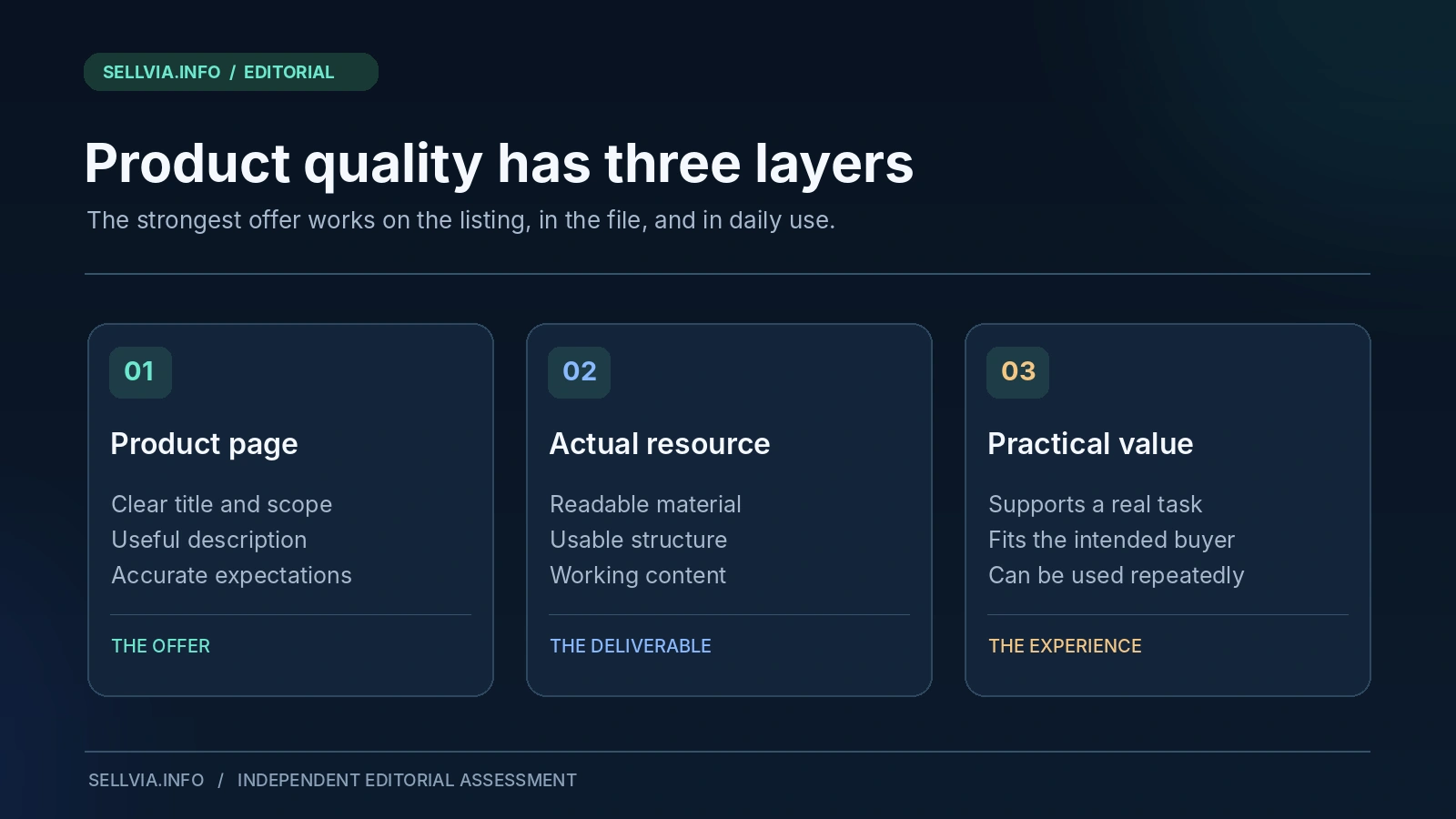
For digital products, the buyer often cannot touch or inspect the resource before purchase. Product-page language therefore carries unusual responsibility. A good page should explain the problem, deliverable, intended user, format, and main limitations without vague superlatives or exaggerated results.
Sellvia says it supplies ready-to-use product descriptions and visual materials. That is an advantage over a bare file directory because it gives the owner a functioning starting point for customer communication. But a responsible store owner should still read each page critically. Prepared does not mean immune from error, and no listing should be published without checking that it matches the resource being offered.
We recommend a two-pass review. Read the page first as an ordinary visitor who knows nothing about the product, and then as an editor responsible for the claims. If the first pass does not reveal what the buyer actually receives, the copy needs clarification. If the second reveals promises unsupported by the file or platform terms, they should be corrected before promotion.
Originality and rights: why this deserves separate attention
A digital resource’s visual appeal says little about who owns the rights to it. Sellvia’s current Terms state that catalog digital products are created internally and covered by its intellectual property rights or licenses, and that they are not merely redistributed PLR content. This is a meaningful published assurance about sourcing.
It should not be misread as a transfer of ownership to the person subscribing to the store. A subscription gives access under the applicable agreement. The underlying materials remain governed by Sellvia’s rights and any terms attached to their use. That is compatible with a useful commercial catalog; it simply establishes the boundary between using provided product access and owning unrestricted source files.
A cautious reader should retain the relevant subscription terms and confirm which catalog privileges remain available while their plan is active. This is not a reason to dismiss the catalog. It is the normal due diligence that makes a positive conclusion trustworthy rather than promotional.
Why a focused assortment improves the perceived value
Catalog quality is also affected by what appears next to each product. A highly useful budgeting planner might feel out of place inside a store whose homepage promises stress-management resources. Visitors assess not only a file but the credibility of the collection around it. A coherent assortment makes the store easier to explain and the customer journey easier to navigate.
Sellvia’s wider catalog is therefore most useful as a source of options rather than an instruction to publish everything. Start with a clear reader problem. Choose a small number of complementary products. Look for progression: introductory material, a practical template, and a more detailed resource for customers who want to go further.
That approach puts the ready-made breadth to work without making the storefront overwhelming. The platform provides a basis for curation; the owner contributes the editorial vision. This division of labor is one of the more convincing practical aspects of Sellvia’s product ecosystem.
A reproducible product-quality audit
A useful audit should be transparent about what makes a product strong. In our editorial process, the product receives credit for a clear promise, usable structure, and appropriate presentation, not because its cover looks attractive. The scoring categories make the quality judgment understandable and repeatable.
For downloadable resources, our quality routine goes beyond the listing. We open the file where access permits, check whether links and navigation make sense, inspect editable fields and formatting, and compare the actual instructions with the customer-facing description. A course gets a different test: lesson structure, clarity, examples, and whether the promised learning outcome is reflected in the material. We judge usefulness by the task the buyer can complete, not by the number of pages shown in marketing copy.
For editorial consistency, we distinguish strong, adequate, and incomplete presentation, always stating what caused the judgment. A strong product does not have to be long. A practical one-page checklist may outperform an oversized workbook when the task is narrow. A well-organized guide can be more useful than a course full of introductory repetition. Sellvia gives merchants room to make those decisions across several digital formats.
For the broader workflow of selecting and presenting products on the storefront, see Sellvia Product Pages Explained and the Sellvia Dashboard Overview. Those guides explain where catalog and storefront work sits in the full system; the present article provides the editorial quality criteria.
What beginners should prioritize first
Our recommendation is to begin with understandable formats that solve a discrete problem. A checklist with a concrete purpose, a planner with a clear workflow, or a guide that answers a specific audience question is easier to evaluate than an abstract promise of transformation. You can judge whether the description makes sense, whether the deliverable is identifiable, and whether related products support the same theme.
The product-level checks that matter most
There is one rule we apply when evaluating a digital product: a polished listing should not have to carry all the weight. If the offer says a spreadsheet will simplify planning, open the spreadsheet and check the relevant cells, instructions, and usability. If it presents a course, examine how lessons move from one skill to the next. If it offers a printable, look at its legibility and whether there is enough space for the task it is supposed to support.
In a store audit, we distinguish three questions. Is the promise clear? Is the resource appropriate for its audience? Does the final presentation make the value easy to recognize? Sellvia’s prepared listing structure is strong at addressing the third question and gives the editor a head start on the first two. It does not eliminate the need to curate, which is exactly how a useful catalog should be handled.
What we would not do is turn a single interesting example into a claim that every product in the collection has identical depth or format. The much stronger editorial conclusion is that Sellvia creates a practical foundation for quality control: choose a coherent range, examine each deliverable that matters, and improve the explanation wherever a buyer could be confused.
Our editorial verdict on Sellvia digital products
Sellvia’s catalog approach is a strong option for someone who would rather select and explain useful resources than create an entire inventory of original ebooks, planners, and courses. What stands out in our review is the combination of prepared storefront presentation, varied digital formats, and a defined platform relationship for the materials. This is a real advantage for getting a coherent store into shape without starting every listing from zero.
Our conclusion is favorable to the model and its documented infrastructure, while intentionally withholding a fabricated numerical quality score for files not accessed. A useful catalog is not proven by its size alone. It becomes valuable when clear, functional resources are selected and presented with care.
Frequently asked questions
What kinds of digital products does Sellvia describe?
Sellvia’s public documents name ebooks, guides, educational materials, courses, checklists, templates, and AI-related resources. Exact product availability should be confirmed in the account’s current catalog.
Are Sellvia digital products simply copied PLR packs?
Sellvia’s current Terms say its catalog digital products are developed internally and are not repackaged PLR content. That is the company’s published sourcing statement, not a file-by-file external forensic audit.
Does a ready-made product page prove the download is high quality?
No. It provides useful presentation and helps a buyer understand an offer. A full quality assessment still requires checking the actual deliverable against the page’s promises.
Are products from Sellvia Mall automatically the same as store-owner catalog products?
Not necessarily. Sellvia Mall explicitly defines itself as a separate service, so its public catalog cannot be treated as proof of an individual ecommerce subscriber’s assigned assortment.
Who should choose the products for a Sellvia store?
The store owner should select products around an audience and a coherent theme, using the available catalog and account-specific options. The point is to curate, not to maximize listing count.
Can a subscriber claim full ownership of the product files?
Do not assume that. Sellvia’s Terms describe company rights or licenses over its digital materials; the subscriber’s use is governed by their service agreement.
Editorial references: Our catalog evaluation uses the current Sellvia Terms of Use, Sellvia’s published product information, and the product-quality framework shown in this article. The diagrams are original editorial tools for assessing a digital offer; they are not screenshots of a subscriber’s dashboard.

Jennifer Mitchel is a contributing author at Sellvia.info who writes about the practical decisions involved in using Sellvia for a digital business. Her research focuses on platform onboarding, product selection, advertising strategy, subscription expenses, and the movement of funds from completed orders to available payouts. Jennifer pays close attention to the questions beginners often face, presenting each topic through straightforward explanations, realistic scenarios, and careful analysis of both opportunities and operational responsibilities.