

Is Sellvia Legit? What Beginners Should Know Before Using the Platform

If you have been researching ways to start an online business, you have probably come across Sellvia and wondered whether it is the real thing or just another hyped-up offer. The search query “is Sellvia legit” gets asked a lot – and that is a fair question to ask before putting time or money into any platform.
This article looks at Sellvia as a SaaS online business platform built around digital product store access, a curated digital product catalog, dashboard tools, built-in marketing features, and a commission and payment workflow. It does not answer the legitimacy question by simply checking whether the company exists. It also looks at realistic expectations, what the platform actually provides, what costs are involved, and what beginners should verify before making any decision.
“Legit” is a starting point, not a finish line. A platform can be real and still have limitations, learning curves, and costs that are not right for everyone. That is what this article is here to help you figure out.
Quick Answer: Is Sellvia Legit?
Based on publicly available information, Sellvia appears to operate as a real SaaS online business platform. The company has been active since 2016, has industry recognition from Forbes Communications Council and Inc. 5000, and has received multiple business and marketing awards. That is a meaningful baseline of legitimacy.
However, “legit” does not mean guaranteed income, automatic results, or zero risk. It means the platform exists, provides real tools and access, and operates with a defined pricing and business model. Whether it is a good fit for you is a separate question that depends on your budget, your goals, your willingness to learn, and whether you understand how the platform actually works.
Before paying anything, users should review Sellvia pricing, understand what the subscription includes, learn how commissions and payouts work, and read a mix of Sellvia reviews – including critical ones. That research process is what this article is designed to support.
What Does “Legit” Mean When Evaluating Sellvia?
When people ask “is Sellvia legit,” they usually mean several different things at once:
- Does the platform actually exist and function?
- Does it provide real access to the tools and features it describes?
- Is the pricing clear and understandable?
- Are the rules around payouts and commissions transparent?
- Are user expectations realistic?
- Are there real limitations worth knowing about?
- Do reviews and complaints reveal anything important?
The word “legit” covers a lot of ground. A platform can be entirely legitimate and still not be the right fit for every user. It can have real tools and still require more effort than the marketing implies. It can pay real commissions and still have payout rules that beginners do not expect.
Evaluating legitimacy properly means looking at all of these factors together – not just asking whether the company has a website.
Sellvia as a SaaS Online Business Platform
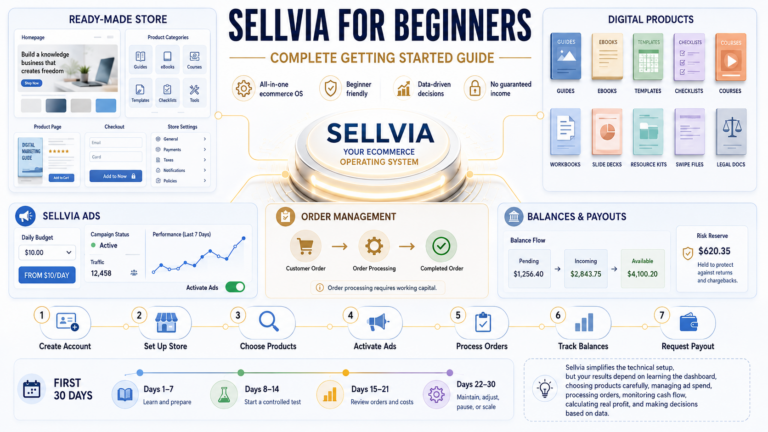
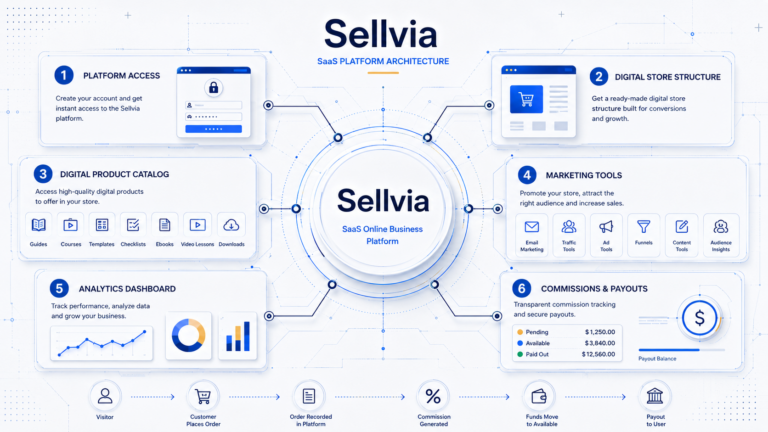
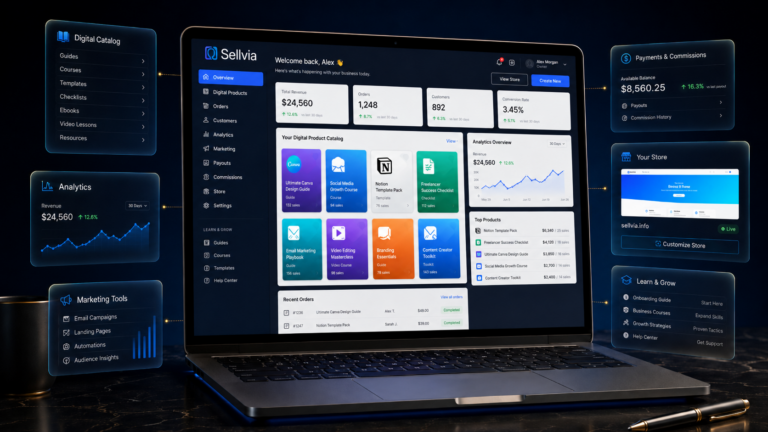
Sellvia is best understood as a SaaS online business platform. That means users pay for platform access – typically through a monthly subscription – and in return get access to a ready-made digital product store structure, a digital product catalog they can sell from, a business dashboard, marketing and advertising tools, analytics features, and a workflow for processing orders and receiving commissions.
The digital products available through Sellvia include guides, courses, checklists, and online tools. These are created and maintained by Sellvia and made available to store owners through the platform. Users do not need to create the initial digital products themselves, because catalog access is part of the platform model.
This model is meaningfully different from building a store from scratch on a generic website platform. Sellvia provides the product infrastructure as part of the service. But it is still a platform – which means the user needs to understand how to work within it, what costs exist beyond the subscription, and what role their own effort plays in whether the business generates revenue.
Sellvia should not be described as a traditional physical-product business model. There is no inventory management, no logistics coordination, and no physical delivery involved. The products are digital and delivered instantly when an order is processed.
What Sellvia Appears to Provide
The Sellvia platform appears to offer:
Ready-made digital product store structure. Users get access to a functional online store pre-loaded with digital products. The store is built for them – no design or technical setup required from day one.
Digital product catalog access. Sellvia maintains a catalog of digital products that store owners can sell. Users can expand their catalog by adding more product packs from the available selection.
Business management dashboard. Users manage their store, track orders, and monitor performance through a central dashboard. This is where most operational decisions happen.
Built-in advertising options. Sellvia includes a built-in advertising system that can drive traffic to a user’s store from major platforms. This is one of the platform’s most cited features and does not require the user to have prior advertising knowledge.
Marketing tools and promotional features. Beyond the built-in ad system, users can access additional marketing-related tools including SEO tools, social media marketing tools, and content promotion options.
Commission and payment workflow. When a sale is made, the user earns a commission on the transaction. Sellvia handles the product delivery and the payment processing workflow. Users need to understand how order processing fees work and when commissions become available for withdrawal.
Platform support. Users are assigned a dedicated growth manager who provides guidance through the platform experience, including setup, early sales, and decisions about upgrade
Why People Ask If Sellvia Is Legit
There are a few consistent reasons people search this question:
Online business platforms often make big claims in their marketing. When an offer sounds unusually good – easy setup, quick results, no experience needed – people naturally want to verify whether it holds up. That skepticism is healthy.
Beginners are frequently the target of misleading offers in the “make money online” space. After seeing enough scams or overhyped products, many people apply extra scrutiny to anything new. That makes the legitimacy question one of the first things they want answered.
Users also want to understand the real costs. The gap between what a free trial offers and what the ongoing subscription requires is not always made clear in initial advertising. People want to know what they are actually committing to before they start.
Payout timing and commission rules are another concern. Many users have experience with platforms that make earning sound simple but complicate the withdrawal process with minimums, delays, or unclear rules.
Finally, some people confuse platform legitimacy with guaranteed earnings. They want to know if the platform works – but what they actually want to know is whether they will personally make money. Those are two different questions, and this article tries to address both.
Legit Does Not Mean Guaranteed Profit
This is one of the most important things to understand before using any online business platform, including Sellvia.
Even if the platform is real and functional, that does not mean:
- Every user will generate revenue
- Results happen automatically without effort
- The subscription fee is the only cost involved
- Traffic appears without active marketing or ad spend
- Commissions are immediately withdrawable without any rules or minimums
- Business fundamentals can be ignored
The Sellvia platform provides structure, tools, and a product catalog. What it cannot provide is a guarantee that your specific store will generate sales. That depends on your marketing approach, your ad budget, your audience, and how well you understand and use the tools available.
Users who go in expecting a hands-off income source are likely to be disappointed. Users who treat it as a real business platform that requires real engagement tend to have a more realistic experience.
Results may vary, and any platform that suggests otherwise should be evaluated carefully.
What Beginners Should Verify Before Using Sellvia
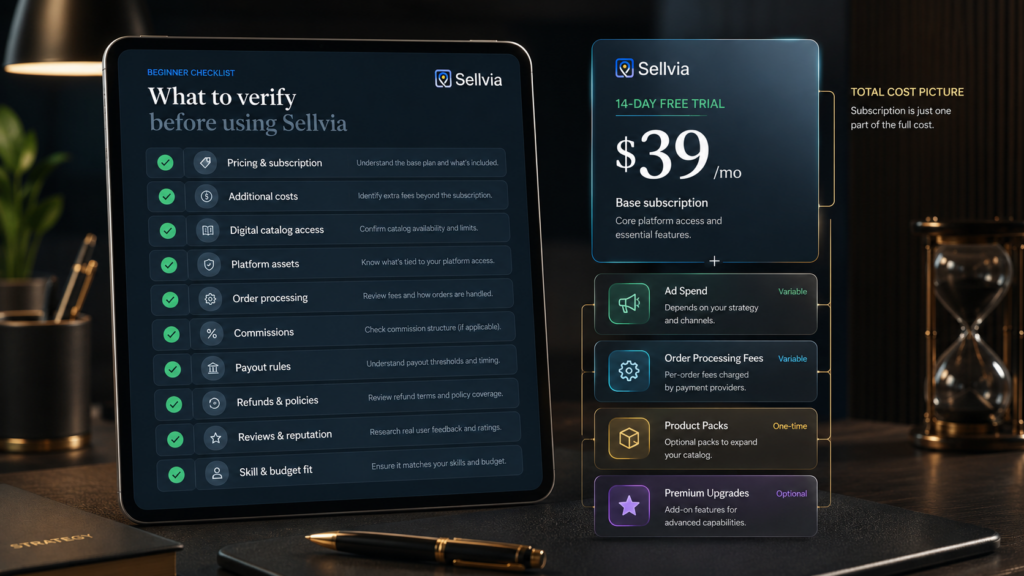
Before starting a trial or paying for a subscription, check the following:
- Current Sellvia pricing – what the monthly plan costs and whether it has changed
- What the subscription includes – what features are part of the base plan vs. what costs extra
- Additional costs – ad spend, order processing fees, product pack purchases, premium upgrades
- How the digital product catalog works – which products are included by default and how to expand the catalog
- What assets are tied to the platform – what happens to your store and products if you cancel
- How orders are processed – what the workflow looks like and what fees apply per order
- How commissions are calculated – what percentage the user earns per sale and how it is tracked
- Payout rules – minimum withdrawal amounts, payout schedule, payment method options
- Refund and cancellation terms – what the policy is if you want to stop
- User reviews and complaints – what real users report about their experience
- Skill and budget fit – whether the platform matches your current level and what you can realistically spend on marketing
Going through this checklist before paying anything is the most practical way to avoid surprises.
Sellvia Pricing and Cost Transparency
Pricing is one of the most important factors in deciding whether Sellvia is the right choice for you. The platform offers a 14-day free trial with a $40 advertising coupon included, which gives users a chance to test the product before paying.
After the trial, the base subscription runs $39 per month. That is the platform access fee. But the total cost of operating a Sellvia-based business can be higher depending on how the user approaches it.
Ad spend is separate from the subscription. The built-in advertising system costs between $10 and $50 per day depending on the user’s budget. This is optional but closely tied to generating traffic and orders.
There are also order processing fees charged when a sale is made, as well as optional costs for expanding the digital product catalog or accessing premium features and upgrades.
Understanding the full cost picture – not just the subscription – is important for anyone with a limited budget. For a detailed breakdown, see the dedicated Sellvia pricing guide.
Sellvia Tools and Platform Features
The Sellvia platform includes a set of tools that go beyond just providing a store. The dashboard gives users visibility into orders, earnings, and store performance. The built-in advertising feature handles traffic generation without requiring the user to manage ad campaigns manually. Analytics and tracking features let users monitor what is happening in their store over time.
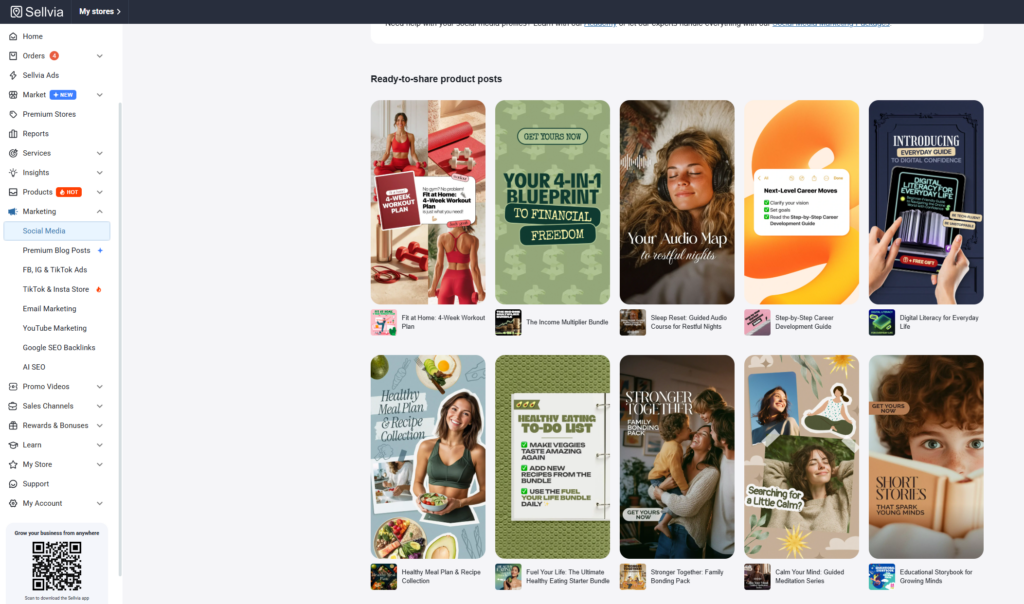
Marketing tools available through the platform include options for SEO optimization and social media promotion, which help users build traffic sources beyond the built-in ad system.
It is worth noting that having access to tools is not the same as automatically getting results from them. Tools require time to understand and use effectively. Users who activate features but do not engage with them are unlikely to see the same outcomes as users who actively work with the platform.
For a full breakdown of what the platform offers, see the guide to Sellvia tools.
Sellvia Reviews and User Feedback
Reading reviews is one of the best ways to calibrate your expectations before using any platform. For Sellvia, it is worth looking at reviews from multiple sources rather than relying on a single rating.
Positive reviews tend to focus on the ease of setup, the structure the platform provides for beginners, the built-in advertising feature, and the accessibility of support. Users who engage with the platform early and activate the advertising tools tend to report more positive early experiences.
Critical reviews often raise points about cost expectations, marketing difficulty, the learning curve involved, payout timing, and the gap between initial marketing promises and the effort required to see results. Some complaints reflect genuine friction points. Others reflect users who had unrealistic expectations going in.
The most useful reviews are detailed ones that explain what the user actually did, what results they saw, and what they found confusing or frustrating. Star ratings alone tell you very little.
Sellvia Complaints: What They May Actually Mean
Complaints about platforms like Sellvia tend to fall into a few recurring categories. Understanding what is behind a complaint is more useful than simply counting them.
Pricing surprises – Some users did not fully understand the costs beyond the subscription before starting. Order processing fees and ad spend can add up quickly if a user is not prepared for them.
Business model confusion – Users who expected a fully automated income source sometimes feel let down when they realize active engagement is required. This is often a mismatch between expectation and reality, not necessarily a platform failure.
Marketing costs – Generating traffic requires either spending on the built-in ad system or investing time in organic marketing. Users who expected free traffic may find this frustrating.
Payout timing – Commissions are not always instantly available. Users who do not understand the payout rules may feel like they cannot access their earnings when they expect to.
Support expectations – Not every user has the same experience with the guidance they receive. Support quality can vary.
Complaints should not be ignored, but they should be interpreted in context. A complaint about “not making money fast enough” is different from a complaint about “I was charged for something that was not disclosed.” The first may reflect unrealistic expectations; the second is a legitimate concern about transparency.
Red Flags to Watch for With Any Online Business Platform
This checklist is not aimed at Sellvia specifically – it applies to any platform in the online business space. Use it as a general research tool when evaluating any subscription-based offer that involves earning potential.
The questions worth asking before you commit to anything:
- Does the platform make income claims with specific dollar amounts presented as typical or guaranteed?
- Is the full cost picture clear before you sign up, or do extra fees appear only after you are inside?
- Are you given enough time to research, or does the offer push you toward a fast decision?
- Are commission and payout rules explained clearly and upfront?
- Are there earning minimums or withdrawal timelines that are only visible in the fine print?
- Do success stories include context about effort, timeline, and individual circumstances?
- Is it clear what the user is responsible for – marketing, traffic, engagement – vs. what the platform handles?
A platform that holds up well against these questions is worth taking seriously. One that deflects or obscures them deserves more research before you pay anything.
Green Flags That Make a Platform More Trustworthy
On the positive side, here are signs that a platform is operating with appropriate transparency:
- Clear pricing before the trial ends
- Understandable terms around cancellation and refunds
- A visible dashboard that shows real performance data
- Realistic language about what results are possible
- Accessible support that does not disappear after sign-up
- Educational materials that help users understand the platform
- Transparent payout rules with clear timelines
- Reviews that reflect a range of user experiences, not just five-star testimonials
- No promises of guaranteed income
Sellvia’s publicly available credentials – Forbes Communications Council membership, Inc. 5000 ranking, and multiple industry awards in ecommerce and marketing – are meaningful trust signals. They do not guarantee a good experience for every user, but they indicate the company operates at a level of public accountability that anonymous schemes do not.
Who Sellvia May Be Legitimately Useful For
The Sellvia platform may be a reasonable fit for:
- Beginners who want a structured starting point without building everything from scratch
- Users interested in selling digital products without creating their own content
- People who want a ready-made store setup rather than configuring one from zero
- Users who are comfortable spending on advertising to generate traffic
- People willing to engage with the platform, learn the tools, and put in consistent effort
- Users who want guidance and support as they work through the early stages
The key word is “willing.” The platform provides structure, but the user still drives the outcome.
Who Should Be Careful With Sellvia
Sellvia may not be the right fit for:
- People expecting fully automatic income without active effort
- Users with no budget for advertising or additional costs beyond the subscription
- People unwilling to learn how the platform, tools, and commission workflow operate
- Users who expect fast results without a marketing plan
- People who do not read pricing terms, payout rules, or platform documentation before paying
- Anyone who believes a platform alone is a complete business
Is Sellvia Legit or a Scam?
This question deserves a direct answer.
Based on available information, Sellvia should be evaluated as a real SaaS online business platform – not dismissed as a scam simply because it involves ongoing costs, has mixed reviews, or operates in a space that attracts skepticism.
The company has verifiable history dating to 2016, real industry recognition, and a defined product model. Those are meaningful signals that distinguish it from anonymous, no-track-record schemes that appear and disappear in the online business space.
At the same time, legitimacy is not the same as a perfect fit. Users should still do their due diligence – understand the pricing, read the reviews, learn how the payout workflow operates, and go in with realistic expectations. A real platform with a learning curve and real costs is not a scam. It is just a platform that requires informed use.
How to Research Sellvia Before Paying
If you want to make a confident, informed decision, follow this process:
- Read what Sellvia is– understand the platform model before anything else
- Learn how Sellvia works– follow the user journey from trial to active store to commissions
- Review Sellvia pricing– understand every cost layer, not just the subscription
- Review Sellvia tools– know which features are available and what they require from you
- Read Sellvia reviews and complaints– look for detailed, experience-based feedback
- Understand payout rules– know when and how commissions become accessible
- Estimate your marketing budget– factor in ad spend if you plan to use the built-in advertising
- Decide whether the platform fits your goals– and your current skill level and budget
Final Verdict: Is Sellvia Legit?
Yes – Sellvia is a real SaaS online business platform with verifiable credentials, a defined product model, and industry recognition. When someone asks “is Sellvia legit,” the honest answer is that the platform exists, operates transparently enough to have real public accountability, and provides actual tools and access to users who pay for it.
But legit and guaranteed-to-work are two different things. The platform may provide access to a ready-made digital product store structure, a curated catalog, dashboard tools, built-in advertising, and a commission workflow. None of that replaces the need for the user to understand what they are paying for, how the marketing works, what the costs actually are, and what realistic results look like.
The right way to approach Sellvia is the same way you should approach any business platform – with clear eyes, a realistic budget, and a willingness to learn before you expect to earn.
Frequently Asked Questions
Is Sellvia legit?
Sellvia is a real SaaS online business platform with verifiable industry recognition and a defined product model. Legitimacy in this context means the platform exists and functions as described – it does not mean every user will earn money or that the Sellvia platform is right for every situation.
Is Sellvia a SaaS platform?
Yes. Sellvia operates on a subscription-based model where users pay for access to a digital product store structure, a product catalog, dashboard tools, marketing features, and a commission workflow. That structure is consistent with a SaaS platform applied to an online business context.
Is Sellvia a scam?
Based on what is publicly available, Sellvia does not fit the profile of a scam. The company has been operating since 2016, has verifiable industry credentials, and has a trackable public presence. Like any platform, it has costs and limitations that users should understand before paying – but costs and limitations are not the same as fraud.
Does Sellvia guarantee income?
No. No platform can legitimately guarantee income, and Sellvia should not be evaluated on that basis. The Sellvia platform provides tools, structure, and product access. Whether those tools generate revenue depends on the user’s effort, marketing approach, budget, and how well they understand the platform. Results vary.
What should I check before using Sellvia?
Before starting, verify the current pricing, understand what is included in the base subscription vs. what costs extra, learn how order processing fees work, read the payout and commission rules, check recent user reviews from multiple sources, and estimate how much you can realistically spend on advertising.
Are Sellvia reviews important?
Yes. Reading a range of Sellvia reviews – including both positive and critical ones – gives you a more accurate picture of what the experience actually looks like. Look for detailed reviews that explain what the user did and what they experienced, rather than relying only on star ratings or testimonials selected by the platform itself.
Is Sellvia good for beginners?
Sellvia is designed with beginners in mind and does remove many technical barriers to starting an online business. Whether it is a good fit depends on whether the beginner is willing to engage with the platform actively, spend on marketing, and learn the tools available. Beginners who expect results without effort are likely to be disappointed.
What should I read after checking if Sellvia is legit?
After confirming the basic legitimacy question, the next steps are understanding what Sellvia is in detail, how Sellvia works from sign-up through earning, what Sellvia pricing looks like at each stage, and what real users say in Sellvia reviews. Those articles together give you a full picture before making any financial commitment.

Jeck Palmer is an ecommerce writer and platform researcher at Sellvia.info. He specializes in analyzing Sellvia’s features, pricing, tools, advertising system, order workflow, and overall business model. His articles are designed to explain complex platform processes in clear and practical language, helping beginners understand potential costs, evaluate available tools, and make more informed decisions before starting an online business.
The legitimacy framing you open with is exactly where I was stuck before I tried this thing, because I kept treating “is it real” as the whole question instead of just the starting point. I came in as a life coach with almost no e-commerce background and genuinely expected to be disappointed within the first week. What caught me completely off guard was not the tools or even the commission structure – it was the moment after my third sale when I opened the dashboard and noticed the company credentials sitting right there, Inc. 5000 ranked at 1818, Forbes Communications Council recognition, over 1.5 million stores already running through the platform. Something about seeing those numbers in that specific moment made the whole thing feel different, less like a gamble and more like I had quietly joined something that had already been proving itself for years before I showed up. I had built my coaching practice on credibility signals, so I understood immediately what those credentials actually represent in terms of vetting and sustained performance. Your point about “legit” not meaning guaranteed income is the part most beginners need to sit with longer than they do. I just wish someone had pointed me toward the credential layer earlier instead of letting me spiral on the monthly cost question for weeks before I even started.
I thought the first week would be the hard part – it wasn’t, the first week was actually the clearest, because the system lays out exactly what you’re accessing before you spend a single extra dollar, which is the opposite of what a colleague at my office experienced paying nearly double for three separate tools that did the same thing badly. Four months in, writing this on my lunch break, and what I’d flag for anyone reading this article is that the section on realistic expectations is doing real work – I almost didn’t sign up because of one negative review, and I talked myself out of quitting at least three times before quietly realizing around week two that a refund had already processed without me chasing it. Small critique though – the article could push harder on what slower-than-expected actually looks like in practice, because my first seven days felt like setup, not momentum, and nobody quite prepared me for that.
The part this article handles well is separating “legit” from “results guaranteed” – but what actually changed my ad spend around day 22 was realizing the SEO package inside this platform was doing quiet work that meant I did not need to fund every single visit myself.
The “legit vs profitable” distinction this article makes is the thing I needed six weeks ago. I kept asking the wrong question. Platform is real. Whether my specific setup works is a different problem entirely.
But doesn’t the line between “legit platform” and “works for most people” matter? If 80% of users don’t net positive, “legit” starts to feel like a technicality.
Fair point but that’s true of every business model. Most restaurants fail. Most Shopify stores make nothing. The platform being real is the baseline – what you do with it determines the rest.
Same realization hit me around day 23. Once I stopped treating legitimacy as the finish line and started treating it as the starting point, the whole evaluation changed. Month three now, net positive.
Ok I’ll grant that. Still think the article could push harder on what “consistent effort” actually looks like in hours per week. That number would help people self-select better.
The checklist before paying is the most useful thing in this entire Sellvia review and I wish I’d had it three months ago. Specifically the payout rules section – I had no idea commissions weren’t instantly withdrawable when I started.
How long did it take for your first withdrawal to clear? I’m at day 31 and still building toward the $100 minimum.
Hit $100 available around day 38. The 72-hour hold on each processed order is the part nobody warns you about clearly. Budget as if you won’t touch earnings for 5-6 weeks minimum.
That’s really helpful actually. I’ve been mentally counting dashboard numbers as available money which is wrong. Thanks for clarifying.
I’ve used three platforms in the last two years. The red flags checklist in this article is the most useful framework I’ve seen for evaluating any of them – not just Sellvia. Saved it.
Which three platforms? Genuinely curious whether Sellvia compares favorably or just less badly than the alternatives.
Two I won’t name – both had undisclosed fees and disappeared support after month one. Sellvia’s costs are higher but at least they’re disclosed upfront and the growth manager actually responds. Different category in terms of transparency.
That transparency point matters more than people give it credit for. Hidden fees are a different problem than high fees. At least with Sellvia review you know what you’re getting into if you read before paying.
Complete beginner question – the article says the built-in ad system doesn’t require prior advertising knowledge. Is that actually true? I’ve never run an ad in my life and this is the part that scares me most.
Yes it’s real. You set a daily budget, activate it, and the platform handles targeting. I had zero ad experience and got my first order day 9. The learning curve is understanding the dashboard not the ad mechanics.
Mostly true with one caveat – you still need to understand what your numbers mean. CTR, conversion, cost per acquisition. You don’t need to BUILD the campaign but you need to READ the results or you’re flying blind.
That’s helpful context. So the platform runs the ads but I still need to understand if they’re working and when to adjust budget?
Exactly. The platform optimizes automatically but basic dashboard literacy matters. Give yourself two weeks before judging any results – the system needs data before it gets efficient.
The article says realistic first month budget is $340. My actual month one was $387 – subscription plus $300 ads plus processing fees on 8 orders. Article’s math is accurate. Nobody told me about the processing fees though.
Processing fees were my surprise too. They’re small per order but they add up and they come off your commission before you see the profit figure. Dashboard shows net anyway so it’s not hidden – just easy to miss when you’re new.
Right – the dashboard shows “your profit” which is already net. I was calculating wrong for two weeks thinking gross was mine. Small thing but it matters when you’re tracking break-even.
What I appreciate about this Sellvia review is that it doesn’t pretend the platform is perfect. The “who should be careful” section is the most honest thing I’ve read about this platform anywhere. If you need fast results with no ad budget, this isn’t it.
This is where I’ll push back slightly – “no ad budget” is relative. $10/day Bronze package is $300/month which isn’t nothing but it’s also not thousands. Some people read “ad budget required” and assume it’s unaffordable.
Fair clarification. I meant people who have literally zero for ads beyond the $39 subscription. At $10/day minimum you’re looking at $340/month total which is accessible for some and not for others. Depends entirely on individual situation.
Coming back to close the loop on my comment above. Six weeks in now. The article’s framework holds up under real use. Platform is real, costs are disclosed, effort is required. For me the math is working – not dramatically, but consistently. That’s enough.