
Sellvia Digital Product Bundles: An Editorial Quality Review
The most convincing digital bundle is not the one with the largest number printed on its cover. It is the one whose parts make a customer’s task easier to finish. That became my main test while reviewing the way Sellvia presents multi-part digital products. A strong set gives the buyer a sensible route from an initial question to a useful outcome: read the guide, complete the worksheet, follow a checklist, and return to the reference material when needed.
Sellvia’s digital-product ecosystem is well suited to this format. It offers a ready-made storefront and a catalog containing guides, courses, planners, checklists and other digital resources. When those materials are grouped for one purpose, they can become easier to explain and more appealing to a customer who wants a complete starting point rather than a single isolated download.
My editorial verdict is positive: thematic bundles are among the clearest ways to demonstrate the benefit of a curated digital catalog. They can organize complementary resources into a purchase that has an understandable purpose. The crucial requirement is that the components genuinely belong together. This review looks at composition, usability, presentation and buyer value, not at inflated claims about automatic sales.
Two different meanings of ‘bundle’ in Sellvia
Before evaluating quality, I separate two uses of the term. One is a customer-facing digital product bundle: an offer that groups several resources for an end buyer, such as a planner, guide, checklist and accompanying audio material. Public Sellvia Mall listings include many examples of these multi-part offers.
The other is a catalog expansion pack marketed to Sellvia store owners. Some public Sellvia materials discuss large themed product collections, sometimes describing hundreds or thousands of digital listings that a merchant can add to a store. That is a different purchase decision. The buyer is expanding a store assortment, not necessarily purchasing one end-user learning package.
Mixing these two models makes reviews confusing. A four-part budgeting toolkit cannot be evaluated by the same criteria as a broad collection of hundreds of store listings. I focus primarily on customer-facing bundles, then explain what the same principles mean for store owners choosing larger catalog packs.
What makes a bundle more useful than separate products?
A coherent set creates a pathway. Imagine someone trying to establish a weekly routine. A single ebook might explain the principles. Add a printable planner and the reader can apply them. Add a checklist and the reader can repeat the process. Add a brief review worksheet and the system supports improvement over time.
The extra value is not simply four files instead of one. It is the relationship between them. Every component has a job, the sequence is clear and the customer spends less effort deciding what to use next. That is the model I find most compelling when reviewing Sellvia’s multi-part digital offers.
From a seller’s perspective, a well-defined bundle can make the product page more specific. Instead of promising "more resources," the listing can say exactly what the buyer receives and why each component matters. That gives the customer an understandable reason to consider a larger purchase without relying on pressure or sensational language.
Public example: The Empowered Budgeting Toolkit
A useful illustration is The Empowered Budgeting Toolkit, which appears in public Sellvia Mall listings as a four-part digital bundle. Its visible product title identifies budgeting and spreadsheet-oriented guidance among the resources. That creates an intelligible structure: explain a budgeting method, give the user a way to record information, and offer supporting material for maintaining the routine.
What I like about this concept is that budgeting is an ongoing task. A reader benefits from being able to revisit a worksheet or reference guide after the first session. A toolkit built around repeat usage has a clearer practical purpose than a one-off motivational message. Its parts can support different stages of the same habit.
A merchant should describe it as educational and organizational material, not individualized financial advice or a guarantee of wealth. The editorial strength lies in a concrete use case. When customers know what the guide and spreadsheet are meant to do, they can make a more informed buying decision.
Public example: Fuel Your Life healthy-eating starter bundle
Another public listing is Fuel Your Life: The Ultimate Healthy Eating Starter Bundle, presented as a four-part digital download that includes written and audio-oriented material. This format shows how a bundle can combine more than one way to learn. Someone may prefer a written reference when preparing a plan and audio material when revisiting ideas later.
The strongest feature of this kind of bundle is format variety with a common purpose. The materials should reinforce the same task instead of repeating identical content in different packaging. I would want the description to explain which component the customer should use first and how the additional pieces support it.
Wellness content also has a higher accuracy requirement. General educational resources are not a substitute for individualized medical guidance. That does not weaken the commercial appeal of the bundle. Clear limits can make the offer more credible and help buyers choose a product suited to their needs.
Public example: Confident Kids Bundle
Confident Kids Bundle: Nurturing Emotional Strength is publicly presented as a three-part resource including a parenting guide, activities for young children and an emotional-intelligence checklist. This example stands out because the components are tied to related but distinct uses: understanding a topic, doing something practical with a child and tracking ideas or observations.
For this type of product, specificity matters. Age suitability, instructions for caregivers and the nature of the activities should be clear. The customer wants to know whether the resource will be practical for their family’s situation. A precise description is much more helpful than promising dramatic personal change.
The editorial appeal is the combination of guidance and action. A parent can move from reading to an activity without needing to assemble a system from unrelated sources. That is the core reason a thoughtfully designed bundle can be more useful than a group of disconnected downloads.
Public example: Time-management and content-planning sets
Sellvia’s public marketplace also presents organization and content-related bundles. A listing such as Content Plan Toolkit to Start Small is attractive because it targets a specific situation: creating content for a modest audience without building an enormous publishing operation. Its value proposition is clearer when the components support planning, execution and review.
A similar logic applies to a time-management course paired with planning resources. The customer needs enough context to understand the method, a template to practice it and a way to revisit it when circumstances change. If a set covers those stages with minimal duplication, the result is more than a collection of files.
As an editor, I find these narrower themes more convincing than bundles described only with broad words such as "success" or "transformation." Buyers are better served by a product that helps with a task they can name, schedule and repeat.
The bundle quality test: cohesion before quantity
I examine a multi-part offer through six practical questions. What is the customer’s main problem? Can the contents be listed clearly? Does each item have a separate purpose? Is there an obvious order of use? Are the files accessible in the formats the customer expects? And does the product page make the combined value understandable without exaggeration?
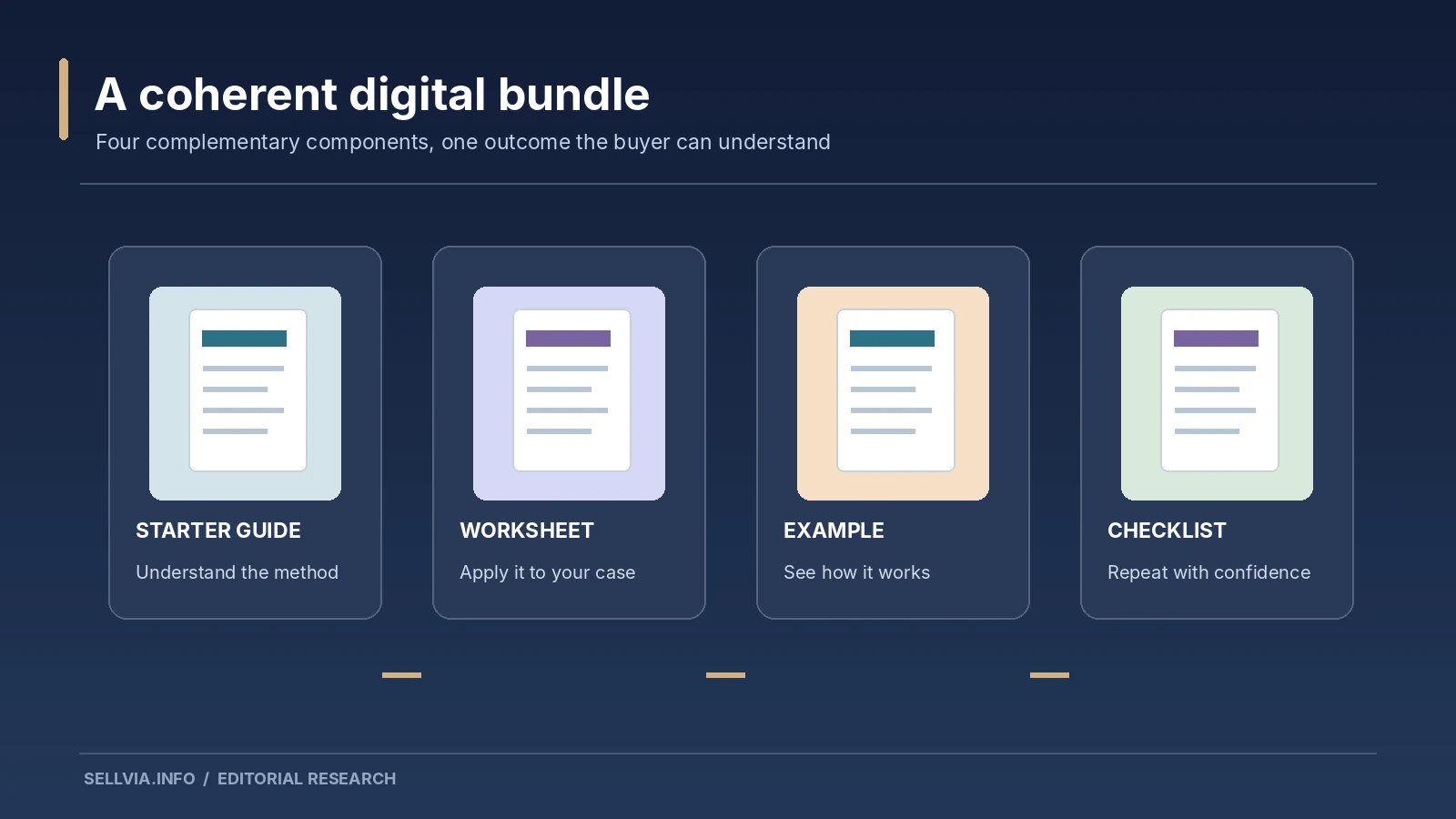
A hypothetical four-part set might contain a quick-start guide, an editable planner, a worked example and a progress checklist. That is a coherent arrangement because each part performs a different job. A set of four nearly identical articles with slightly different titles is not the same thing, even if the product page looks impressive.
This practical method helps merchants decide what deserves a place in the store. Clear organization helps the buyer and makes marketing easier for the seller.
Why the format mix deserves close attention
Bundles can combine PDFs, worksheets, editable documents, audio lessons, video materials and interactive files. That variety can be valuable, but only if the buyer understands the format of each item. A beautiful cover does not tell someone whether they need a spreadsheet application, a browser or a particular AI service.
I want a listing to state what can be opened on a phone, what is better on a computer and whether the user can print, edit or save the material. A checklist meant for regular use should be easy to revisit. A spreadsheet template should be described honestly as a template, not as an automated financial service. An audio course should say what subjects the lessons address.
Sellvia’s prepared product descriptions give merchants a head start in explaining these details. That is a meaningful strength of a ready-made catalog, especially for products with multiple components. The merchant’s role is to inspect the explanation and keep the final offer accurate.
A bundle can be a guided learning path
The best educational bundles feel like a short curriculum rather than a pile of downloads. Consider a customer learning a new organizational skill. First comes a clear orientation explaining the goal. Next comes a lesson or example. Then a worksheet for practice. Finally, a checklist helps the buyer review what has changed and decide what to do next.
A store owner can explain this pathway directly on the product page: "Understand the method, complete the exercise, apply the template, then review the results." This is more informative than repeating "premium bundle" five times. It also gives a customer an honest sense of the effort needed to benefit from the purchase.
I would favor bundles with a beginning, a middle and an end, even when the contents are designed for ongoing use. A clear path makes them more approachable to beginners and easier to recommend to a customer who has a particular task in mind.
How I would merchandise three related bundles in one store
Imagine a digital store focused on calm daily organization. A sensible layout could present one starter bundle for planning the week, a second for family routines and a third for personal productivity. They have related audiences and purposes, but each serves a distinct need.
The homepage should explain the overall theme before showing the products. A short category description can help visitors choose which problem they want to address. Individual product pages then provide the component list, expected format and examples of use. Related-product links should feel helpful, not forced.
This is where Sellvia’s ready-made ecosystem becomes useful. The merchant can work with existing digital listings, curate them into a consistent storefront and concentrate on how customers navigate between related offers. The platform reduces the blank-page work involved in building the assortment.
Are more components worth a higher price?
Only when those components add a meaningful benefit. A buyer may reasonably value several complementary resources more than a single guide, especially when a bundle gives a complete workflow. But price comparison should use the actual current offer and the practical role of each item, not an invented rule that every multi-part product is automatically a bargain.
For instance, four resources are not necessarily four separate purchases of equal value. Sometimes the central guide does most of the work, and the supporting files make it easier to apply. That can still justify a bundle, provided the description is honest about what is included and why it helps.
My editorial advice is to focus on usable completeness. Can the customer accomplish a defined task without hunting for basic missing materials? That is a stronger value argument than a large discount percentage displayed without sufficient context.
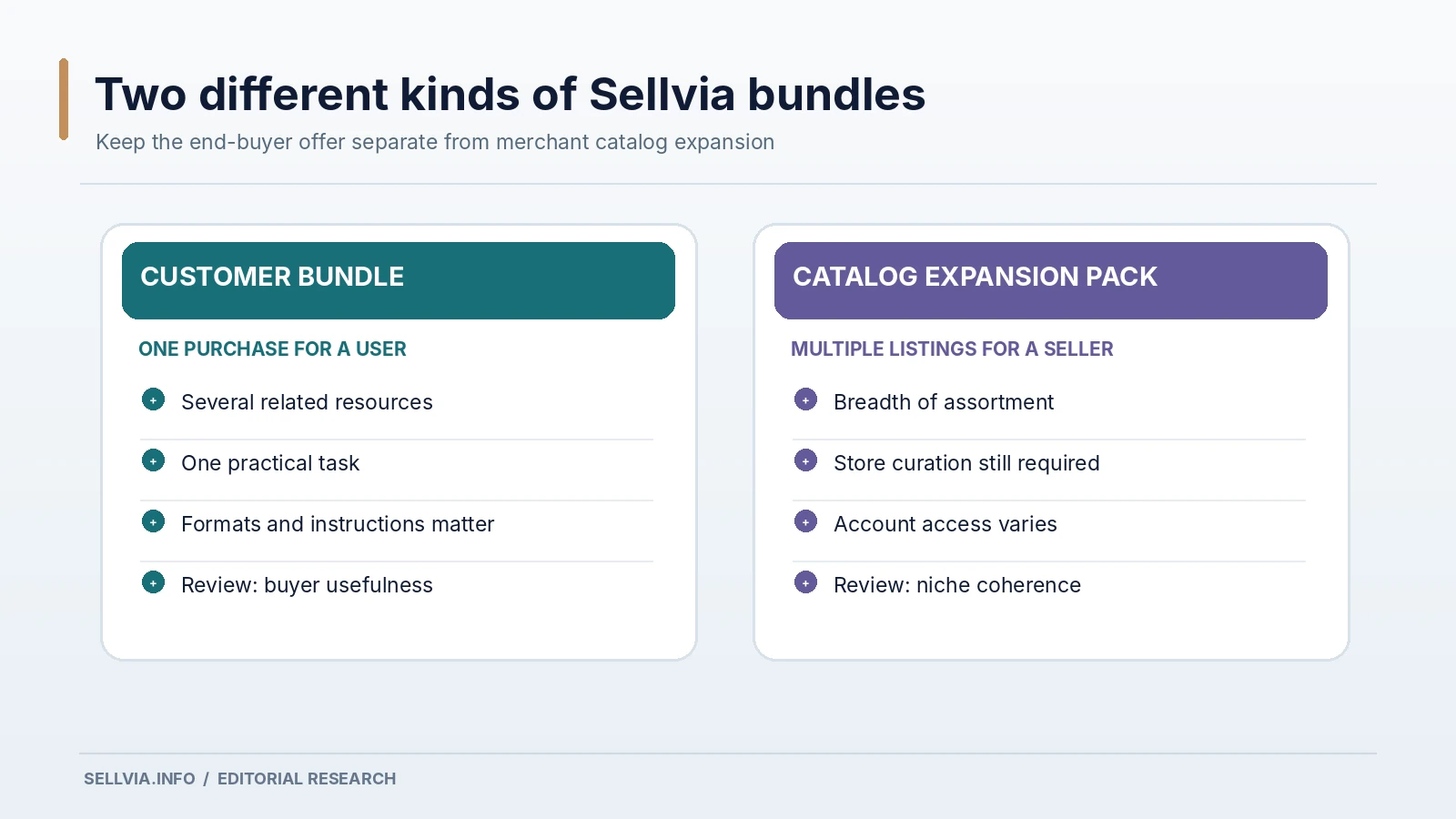
The difference between a customer bundle and a catalog expansion pack
A merchant considering a large Sellvia catalog pack faces a different challenge. A collection containing many digital-product listings may provide breadth, but the owner still needs to decide which categories belong in the store. Hundreds of available items do not automatically create a coherent customer experience.
The positive case for these packs is convenience and optionality. A larger selection may offer more opportunities to build themed groups without producing every product independently. The risk is simply poor curation: adding unrelated listings until the store loses its identity. That is an editorial choice the merchant can control.
I would first identify the audience, then shortlist relevant products from any larger pack and finally review the page and rights attached to the offers available to that account. Our Sellvia Product Catalog Explained guide examines the wider selection process. This review concerns the value of the finished bundle to its buyer.
What prepared listings do particularly well for bundles
A multi-part digital offer asks the product page to carry more information than a single ebook. The page needs a clear title, a concise promise, a component list, format details and a purchase path that does not confuse the visitor. Ready-made listings can provide that structure before the merchant begins customizing anything.
I like the fact that this shifts the store owner’s work toward quality review and presentation. Instead of spending hours formatting a new page for each component, the owner can focus on questions such as: Is the sequence understandable? Are the files complementary? Is this the right offer for my audience?
The fundamentals of the customer-facing page are discussed in Sellvia Product Pages Explained. Bundles add a distinct challenge: explaining the relationship between the parts. That relationship should be visible before checkout, not discovered only after purchase.
A practical bundle audit before promotion
I would begin with the title and summary, then compare every named component with the detailed description. A customer should not need to guess whether "planner" means a printable PDF, editable spreadsheet or interactive application. Next I would review the logical order of the contents and check that none of the important steps depends on an unexplained third-party service.
Then I would open the customer-facing page on a phone. Long component lists can become difficult to scan, so headings and spacing matter. The page should communicate the main benefit without burying it under every feature. Finally I would check the store category and related products. The bundle should belong naturally where customers will find it.
Only after that would I decide how to promote it. A strong product concept can still be undermined by a vague advertisement or a mismatched landing page. The useful advantage is that Sellvia gives merchants a prepared structure in which these checks can be performed without building the entire commerce system first.
How bundled resources support repeat customers
An effective digital bundle can remain useful after the first download. A planning worksheet may be filled in weekly. A study guide can be revisited before a new project. An activity collection can be used more than once. These repeat-use patterns matter because they give the buyer continuing value from the original purchase.
For a store owner, this also creates natural editorial content. A helpful article might explain how to introduce a weekly planning routine, while the associated bundle gives readers the worksheets and examples to apply that method. The article serves the buyer’s question; the bundle offers a structured way to act on the answer.
That is a better long-term approach than relying on novelty or urgency. It helps the store build a recognizable subject area and gives visitors a reason to look at several related resources.
Our editorial verdict: bundles show the catalog at its most practical
I am favorable toward Sellvia’s thematic digital bundles because they make the platform’s ready-made content model tangible. A buyer can see several connected resources aimed at one task. A merchant can select coherent offers, present them with prepared pages and add useful context around them. The best examples are specific, organized and easy to understand.
My preferred bundles are not necessarily the biggest. They have complementary components, clear formats, honest expectations and a straightforward usage path. They help the customer do something rather than merely collect downloads. Sellvia’s digital catalog provides a convenient foundation for that kind of storefront.
For anyone curating a store, I would begin with a small number of well-explained thematic bundles and expand only when the next addition genuinely serves the same audience. That keeps the positive advantages of catalog breadth and ready-made presentation without sacrificing focus or credibility.
Frequently asked questions
What is a Sellvia digital product bundle?
A customer-facing bundle groups related digital resources into one offer. Depending on the listing, the contents may include guides, workbooks, templates, audio, courses or checklists.
Is a bundle the same as a Sellvia product pack for merchants?
No. A customer bundle is one end-user offer with multiple components. A merchant pack may provide numerous products or listings for expanding a store’s catalog. The purchasing purpose is different.
Are bundles always better than single downloads?
Not always. Bundles are valuable when the parts complement one another. A single focused guide can still be the better choice for a narrow task.
What should a product page explain first?
The buyer’s problem, the main outcome, the component list and the formats. The customer should understand how the resources fit together before purchasing.
Should I offer bundles in every category?
Only where several resources genuinely support the same buyer need. A coherent store with a few well-chosen sets is stronger than one full of unrelated bundles.
How can I choose the strongest bundle for my store?
Start with a specific customer task. Compare the component list, the formats and the order in which the resources are meant to be used. The strongest choice is the one that fits your store audience and provides a coherent route from learning to action.

Jennifer Mitchel is a contributing author at Sellvia.info who writes about the practical decisions involved in using Sellvia for a digital business. Her research focuses on platform onboarding, product selection, advertising strategy, subscription expenses, and the movement of funds from completed orders to available payouts. Jennifer pays close attention to the questions beginners often face, presenting each topic through straightforward explanations, realistic scenarios, and careful analysis of both opportunities and operational responsibilities.