Sellvia Digital Product Rights: Original Content and Seller Access
A ready-made digital catalog is valuable for a reason that rarely gets enough attention: it lets an operator spend less time negotiating individual content licenses and more time deciding what customers should see. But that advantage only works when the seller understands the difference between permission to offer a product, ownership of its underlying files, and the customer’s rights after purchase. Those are three different questions, and treating them as one can create unnecessary confusion.
I approach Sellvia digital product rights as a practical store-management issue, not as a vocabulary quiz. When a guide or template fits the niche, I want to know whether it can appear in the store, whether its presentation can be improved, which transaction model applies, and what happens to access if the subscription ends. Those checks directly affect how confidently a seller can promote the offer. My editorial judgment is positive: Sellvia’s managed catalog model removes much of the sourcing burden associated with assembling a digital shop from disconnected third-party files. The trade-off is that access to Sellvia’s content should not be mistaken for ownership of an independent content library.
A simple way to think about the rights: three separate layers
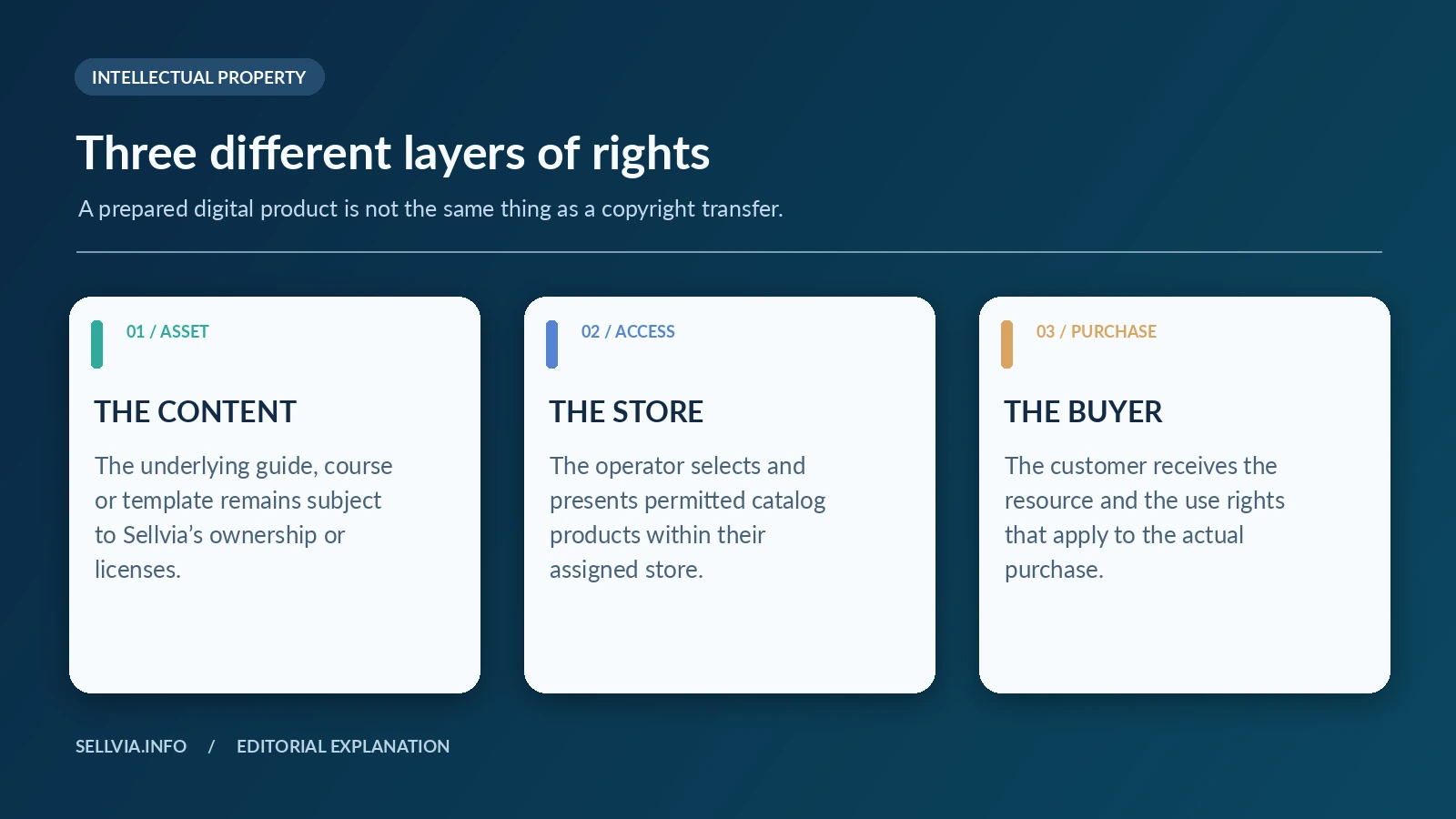
Start with the asset, the selling permission, and the customer’s purchase. The asset is the ebook, course, checklist, template or other material prepared by the content provider. The selling permission defines how a particular shop may display and offer it. The customer transaction determines what the buyer receives and which business handles payment, access and service. A good digital storefront keeps those layers aligned.
This matters because the word my appears all over ecommerce dashboards: my products, my store, my catalog. Those labels are convenient navigation, not proof that a copyright assignment took place. Likewise, displaying a cover on a branded storefront does not automatically mean the store operator can export its source files, resell the raw design elsewhere, or create an unrelated licensing business around the content. I would make that distinction before investing in marketing, not after the first customer asks for a different file format.
For Sellvia’s current catalog, the company’s Terms of Use identify the underlying materials as created or licensed by Sellvia. They also describe digital downloads such as guides, ebooks and educational materials. From a seller’s point of view, the most useful interpretation is straightforward: the platform supplies product infrastructure and permission-based access within its ecosystem; the operator supplies selection, positioning and ongoing attention to the buyer experience.
What Sellvia’s original-content approach changes for a small store
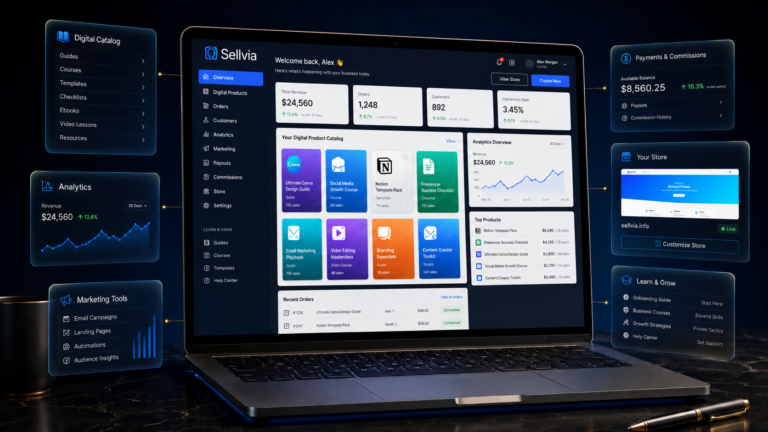
A beginner building a digital shop independently may have to commission writers, hire designers, license visual assets, check resale conditions and create a product page for every item. Those tasks are not glamorous, but missing any of them can undermine an otherwise polished launch. Sellvia offers a more integrated starting point. It provides prepared digital products together with the store environment in which they can be presented.
I particularly like the operational separation. The operator can ask, “Does this planning guide belong next to these budgeting templates?” instead of, “Who owns the rights to this file I bought from an unknown marketplace?” That does not eliminate the need to review the product, but it changes where the work happens. Product selection and customer communication become the priority rather than constructing the entire supply chain from scratch.
Sellvia states that its catalog materials are created internally and are not repackaged PLR. That is a meaningful sourcing policy, although the statement itself should not be confused with a forensic audit of every page and graphic. The practical benefit is consistency of responsibility: a seller has an identifiable platform behind the catalog rather than a collection of unrelated file vendors. In my view, that is a better foundation for a coherent store brand.
Access to a catalog is not a transfer of intellectual property
The most important rights question is also the easiest to explain. A subscriber may be able to select and offer a resource while the copyright or controlling license remains with Sellvia. These statements are not contradictory. Restaurants sell licensed beverages without owning their trademarks; software subscribers use powerful applications without owning the source code. The same general distinction applies to managed digital content.
I do not recommend describing Sellvia-provided downloads as “original files personally owned by the seller” unless a separate written agreement explicitly grants that right. It is also misleading to describe a subscription as an automatic transfer of permanent, unrestricted resale rights. Sellvia’s current terms reserve ownership or licensing of its catalog materials to the platform. Sellers should describe their offer as access to products made available through Sellvia, not as a sale of Sellvia’s intellectual property to the store operator.
This distinction becomes especially useful when evaluating the business itself. A seller may develop audience knowledge, branding and merchandising decisions through day-to-day operations, but those efforts do not necessarily turn a licensed content library into a transferable asset. Clear expectations from the beginning make future decisions less stressful and allow the owner to concentrate on what the account genuinely controls.
The practical permissions question: what belongs in the store?
The first decision I make when assessing an offer is whether the specific product appears as available for the relevant store and plan. A catalog page can describe a promising guide, yet the current account may have a different default assortment or require an additional package. The seller-facing catalog and the live consumer-facing shop should therefore be treated as two views of the same workflow, not interchangeable lists.
Once a product is available, I look at four things. Does it fit the audience? Is the title understandable without internal jargon? Does the cover correspond to the promised material? Can a prospective customer tell what format and benefit to expect? None of these checks requires the operator to claim ownership of the content. They are merchandising decisions made within the store’s permitted environment.
For example, a beginner-focused financial-planning store might present a budgeting workbook near a savings planner and a practical spending checklist. That creates a useful pathway through related resources. A wellness store might take the same approach with habit trackers and reflection guides. These are editorial examples of assortment design, not claims about an exact product inventory assigned to every Sellvia subscriber.
Our product catalog walkthrough covers where available products appear. The separate rights question is what the operator is allowed to do with those products once selected. Keeping those subjects apart makes both articles more useful.
Rights to product files versus rights to product descriptions
Digital ecommerce has several layers of creative material: the delivered resource, its cover, the page copy, display images, promotional snippets and perhaps a video. It is tempting to treat them as one bundle of unrestricted content, but the permissions may differ. A right to show an item in an approved Sellvia store does not automatically authorize extracting and redistributing the original asset in a different service.
My preferred practice is to distinguish presentation from reproduction. A seller can improve how a permitted product is introduced through legitimate store controls: category placement, accurate contextual copy and clearer explanations of whom it helps. But republishing the full ebook as a free lead magnet, removing ownership notices, uploading raw source files to another marketplace or sublicensing the pack to unrelated sellers are different activities. Those require explicit permission, not assumptions.
The safest positive strategy is also better marketing: build distinctive value around selection and guidance. A store can be memorable because it organizes a useful digital catalog unusually well, explains each product clearly and provides a better route for the buyer. It does not need to pretend that every underlying worksheet was written by the operator.
How the transaction model changes the seller’s responsibilities
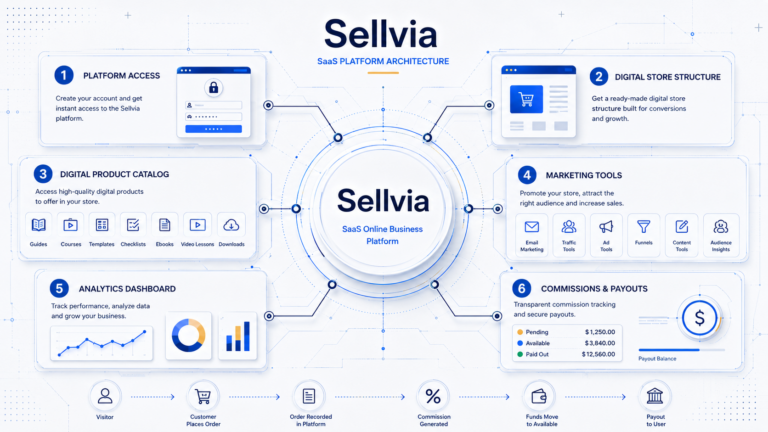
There is another distinction I consider essential before writing a product policy or an About page. Under Sellvia’s current terms, a Storefront without a connected independent payment system directs the buyer to the platform-managed purchase process for transaction completion. Sellvia is the seller for that transaction. Under a Customer-Managed Payments configuration, the store operator handles the customer-facing sale through their own payment integration and assumes the related selling responsibilities.
That difference is more than a technical detail. It affects who accepts payment, issues the relevant transaction documentation and handles payment-related obligations. It is not responsible to tell every Sellvia user, without qualification, that they are the payment recipient for every sale made through a promotional storefront. Equally, it would be wrong to tell an independently configured merchant that Sellvia always accepts the buyer’s payment on their behalf.
I like the existence of a model distinction because it lets operators understand the role they are actually taking. A newcomer can focus on presenting the catalog within the configured storefront journey, while a merchant using independently managed payments needs a more explicit customer-service and transaction process. The appropriate model is the one assigned to the store, not the label a marketing article happens to use.
For a dedicated breakdown of these paths, see Sellvia Store Models Explained. In a rights review, the key takeaway is that selling permissions and payment responsibilities must be understood together.
What does the buyer actually acquire?
The customer is not generally buying a copyright assignment when purchasing an ebook, guide or template. They are buying access to the digital resource under the applicable purchase and content terms. That is why a good product page should explain the format, the contents, any account or download requirements, and the intended use without promising sweeping legal permissions that the shop has not granted.
Consider a planning workbook. A buyer reasonably expects a usable workbook they can read or complete. The purchase does not, by itself, mean they may rebrand the workbook, resell thousands of copies, or license it to other businesses. For a training guide, the customer may want to study its contents, but that does not make the course a transferable publishing asset. These distinctions are familiar in digital commerce and help prevent confusion long before an intellectual-property dispute arises.
I would rather see a short, accurate description such as “downloadable planning resource for personal use, subject to product terms” than a dramatic promise of unlimited commercial rights. Clear language protects the customer experience and increases trust. Sellers should follow the actual product-level license where one is supplied; this article cannot replace those account-specific conditions.
Branding a catalog without claiming to have created it
There is plenty of space for a store to feel distinctive even when it uses platform-provided materials. Brand identity comes from audience choice, visual consistency, navigation, editorial explanations and the overall buying journey. A carefully chosen assortment can look more trustworthy than a large, random collection, regardless of who authored the underlying downloads.
In my own editorial framework, I begin with the audience’s questions rather than the seller’s urge to add volume. Someone seeking a simple routine planner does not need an enormous carousel of unrelated AI prompts. They need a credible starting point, useful category labels and a clear description of the expected result. The store can make that decision intelligently while respecting the provider’s rights.
There is also a meaningful difference between writing an original description of why a product is useful and claiming to be the creator of the product itself. The first is a legitimate editorial contribution. The second needs evidence. The most persuasive Sellvia stores lean into well-organized guidance and confident product presentation without using false authorship claims as a marketing shortcut.
A short working matrix for common seller decisions
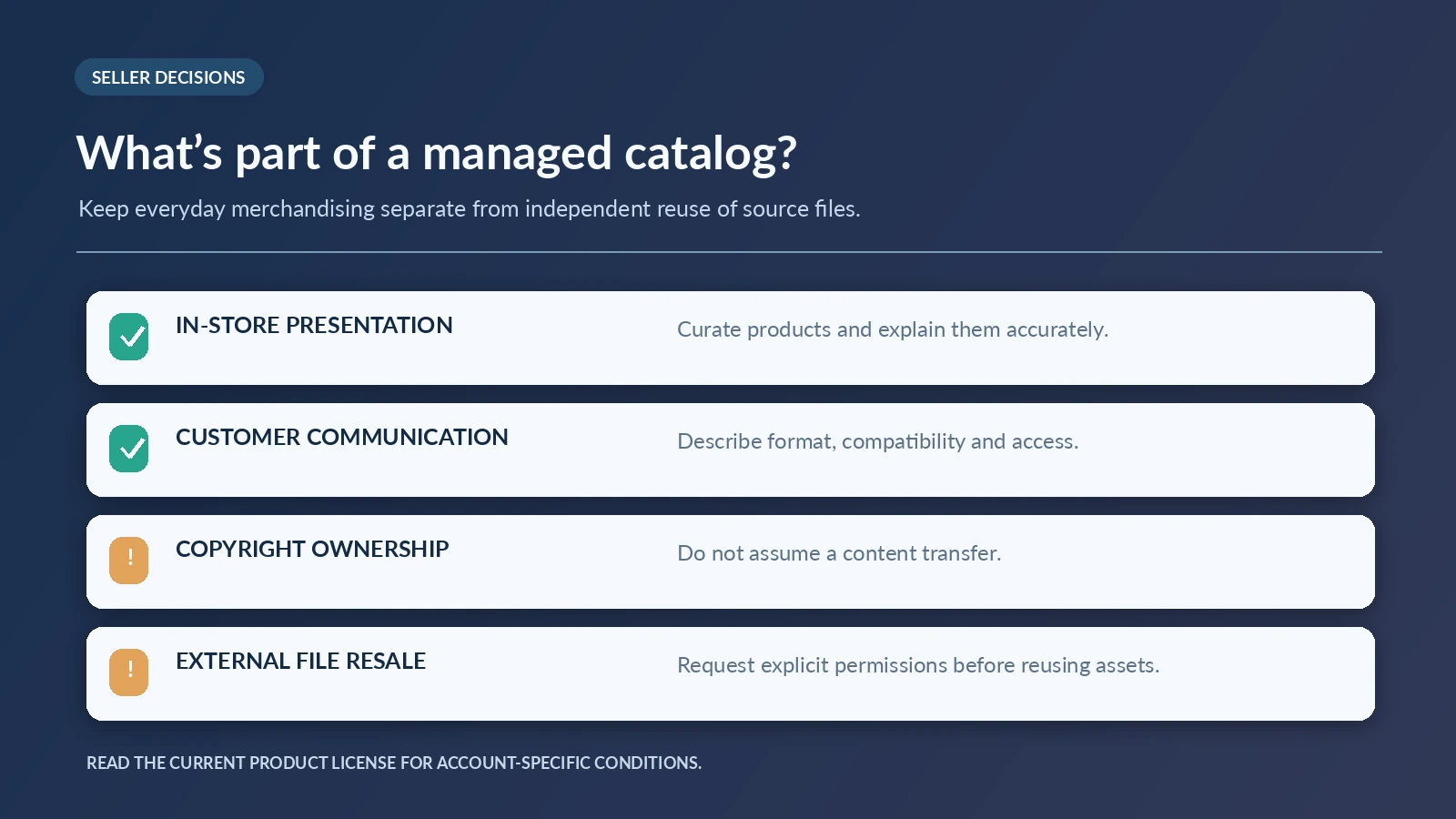
| Seller action | Editorial assessment | Reason |
|---|---|---|
| Display a currently available product through the assigned Sellvia store | Core intended use | Fits the managed catalog workflow |
| Organize approved products into useful categories | Strong practice | Improves customer discovery without asserting file ownership |
| Write accurate, original supporting copy | Strong practice | Adds brand-specific context to the product offer |
| Claim copyright over Sellvia’s original files | Not supported by ordinary catalog access | Access is not an intellectual-property assignment |
| Export raw catalog files for unrestricted resale elsewhere | Requires separate explicit permission | External redistribution is different from in-platform selling |
| Give buyers promises of unlimited redistribution rights | Verify product-specific license first | Customer use and commercial sublicensing are separate issues |
These decisions are deliberately practical. They are not an exhaustive legal ruling on every possible file, territory or promotional service. They help a busy operator avoid a preventable category error: confusing a storefront’s control panel with a copyright registration.
The subscription question that affects long-term planning
A managed store is a continuing service relationship. That is generally a strength for somebody who values a prepared environment, hosting and product access, because there is less independent infrastructure to maintain. It also means the account’s continuing permissions matter. A seller should not assume that canceling the subscription converts every store component, product file and integration into a permanently owned standalone business package.
When I evaluate a digital business, I separate four things: the brand’s audience relationship, the operator’s original work, any registered domain arrangements and third-party licensed content. Different assets may be subject to different transfer or access conditions. Sellvia’s current terms explain that its turnkey store and content rights have platform-specific restrictions. An operator planning a later sale or migration should understand those before describing the business to another person.
My favorable view of Sellvia does not depend on pretending the arrangement is something else. Many users actively prefer a managed service because they want the simpler operational model. The right question is whether that model suits the goal. For a focused digital-products storefront, access to a professionally prepared catalog can be more useful initially than negotiating independent licenses to dozens of files.
Customer questions worth answering before launch
A good rights policy is not a wall of legal terms. It is a short collection of answers customers can actually use. What file or resource will I receive? How do I access it? Is it a guide, an editable template or a course? Can I use it for my own work? Is the product suitable for commercial projects, or only personal learning? What should I do if the file is unavailable? These questions should guide copy on relevant product pages and support responses.
I also look for consistency between the promotional page and the final purchase environment. A customer who sees a digital workbook in a branded storefront should not discover a completely different offer at the transaction step. If the store uses a platform-managed purchase route, the original product title and promised benefits should remain recognizable. This is an operational trust issue as much as a licensing issue.
An accurate, welcoming product page is often enough to prevent common misunderstandings. If the product includes editable materials, say which applications or file formats are supported when known. If the resource is informational, avoid implying that it includes individualized financial, medical or legal advice. The more precisely a seller frames the product, the less they need to rely on generic assurances.
Editorial verdict: simpler sourcing, clearer responsibility
My conclusion is favorable for the reader who wants to operate a focused online shop rather than start a content-production agency. Sellvia’s most practical strength is not a magical right to reuse files without limits. It is a prepared digital-product environment in which sourcing, presentation and store operations can fit together without requiring the beginner to build every component independently.
The best way to benefit from that environment is to respect the division of responsibilities. Sellvia controls or licenses the underlying catalog materials. The subscriber selects a coherent assortment, presents products accurately and follows the rules of their store’s transaction configuration. The buyer receives the digital resource and the usage rights actually associated with that purchase. When all three positions are clear, the resulting store can be professional, easy to understand and credible.
I would recommend this model to a beginner who values a managed catalog and wants to learn merchandising, audience research and customer communication. I would not describe it as a substitute for a separately negotiated intellectual-property assignment. That honest distinction makes the positive case stronger, because it tells the seller exactly where the convenience comes from and what they should build on top of it.
Frequently asked questions
Do I own Sellvia digital products when I add them to my store?
Adding an available product does not, by itself, transfer the underlying copyright. Sellvia’s current terms identify the platform as the creator or rights holder of its catalog digital materials. Your permissions follow the agreement for your store.
Can I sell Sellvia digital products through my assigned store?
Offering the available digital catalog within the Sellvia environment is the intended service model. Confirm that a particular resource is enabled in your account and that you are following its applicable use and transaction rules.
Are Sellvia digital products PLR packs?
Sellvia says its current catalog digital products are created internally and are not repackaged PLR materials. That is the provider’s published statement about sourcing; it does not grant a subscriber unrestricted sublicensing rights.
Can I move the product files to another website?
Do not assume so. Moving raw files outside the permitted Sellvia workflow or reselling them through a different system requires permission consistent with the applicable license. Store access alone is not proof of unrestricted external redistribution rights.
What is the biggest practical advantage of the managed catalog?
The operator can spend more time on product selection, audience fit and the customer-facing experience instead of separately sourcing and licensing every guide, checklist or course.
Editorial references: Sellvia Terms of Use, Sellvia Product Catalog Explained, and Sellvia Product Pages Explained. Product availability and permission details depend on the current store agreement.

Jeck Palmer is an ecommerce writer and platform researcher at Sellvia.info. He specializes in analyzing Sellvia’s features, pricing, tools, advertising system, order workflow, and overall business model. His articles are designed to explain complex platform processes in clear and practical language, helping beginners understand potential costs, evaluate available tools, and make more informed decisions before starting an online business.