
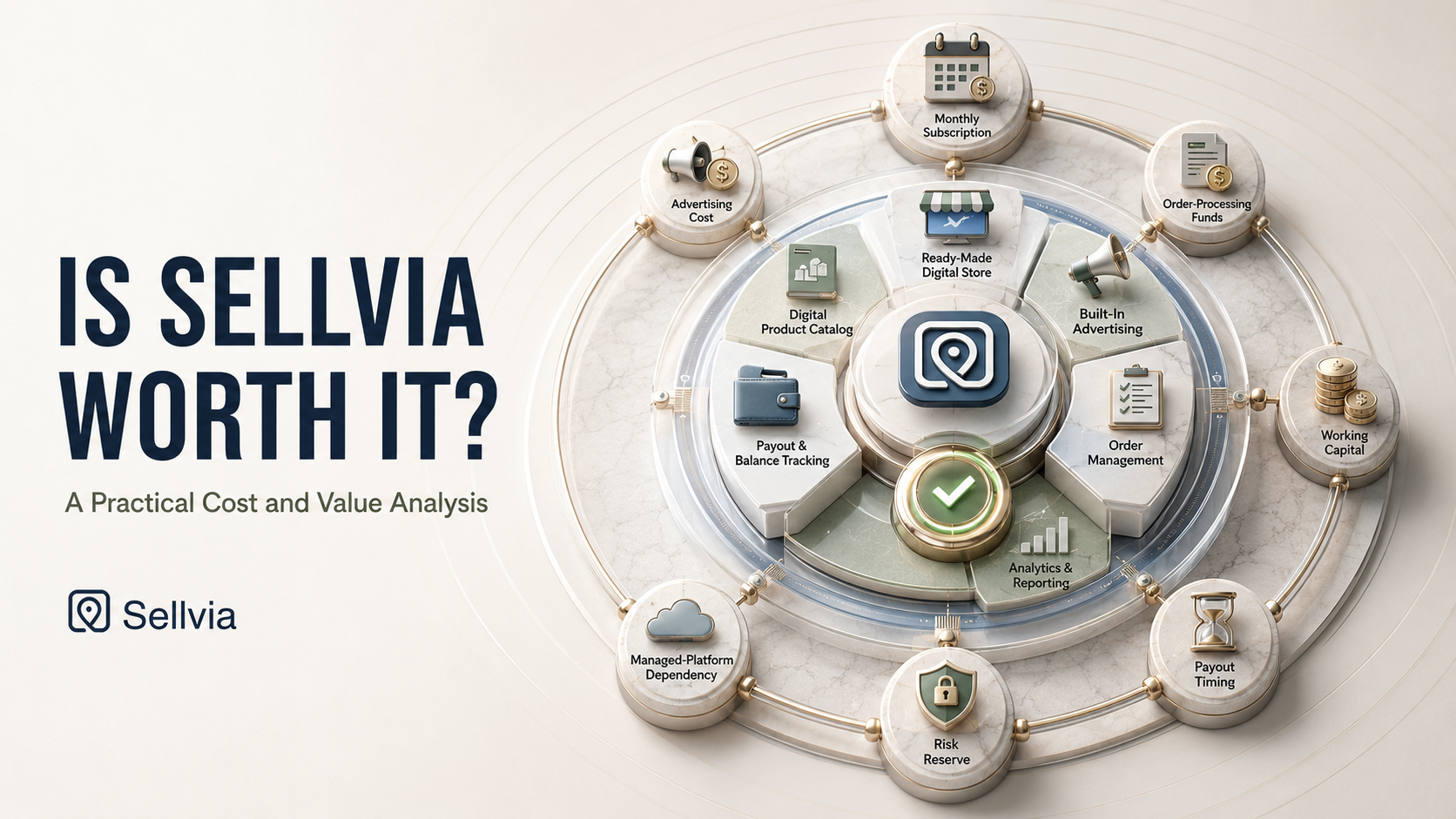
Is Sellvia Worth It? A Practical Cost and Value Analysis
Is Sellvia worth it? The short answer is that it depends on what you compare it to. Judged only against the $39 monthly subscription, the question is incomplete. Judged against the technical work, tools, and setup time a beginner would otherwise need to assemble on their own, the answer looks very different for the right kind of user.
Sellvia combines a ready-made digital store, a catalog of digital products, a built-in advertising system, order management, reporting, balance tracking, and payout infrastructure into a single subscription. That combination is the real subject of this analysis. We are not simply asking “how much does Sellvia cost,” but “what does Sellvia replace, and does that replacement justify the complete operating cost, including advertising, order-processing capital, and payout timing?”
This article treats Sellvia the way a SaaS and ecommerce analyst would: by separating fixed platform cost from variable operating expenses, by distinguishing recorded commission from money that is actually available to withdraw, and by being honest about who benefits most from a managed platform and who may not. For a broader introduction to the platform itself, see our independent Sellvia guide and our dedicated explanation of what Sellvia is.
This analysis focuses on the beginner-oriented Sellvia offer built around a ready-made store, digital products, integrated advertising, order management, and balance tools. Sellvia’s broader ecosystem may include additional ecommerce formats and services.
Our starting position is qualified but positive: for a beginner who wants a structured digital-product business and would otherwise need to piece together several separate services, Sellvia can provide meaningful value. It becomes less suitable for someone with no operating budget, someone expecting guaranteed income with no monitoring required, or someone who insists on owning every technical component independently.
Is Sellvia Worth It? Quick Answer
Yes, for the right user, and under specific operating conditions. Sellvia’s strongest value comes from combining a ready-made digital store, a digital product catalog, built-in advertising, order management, reporting, balance tracking, and payout infrastructure into one place, rather than requiring a beginner to research, purchase, and connect each piece separately.
The monthly subscription is not the complete operating budget. A realistic assessment also needs to account for advertising spend, order-processing capital, any applicable Performance Tier fee if a tier is activated or applied under the current dashboard rules, and the reality that recorded commission moves through several balance stages before it becomes withdrawable cash. Once those factors are priced in, Sellvia tends to be worth it for beginners who have a modest but real advertising budget, who can maintain a small processing buffer, and who are willing to check their numbers rather than judge success by order count alone. It is less worth it for someone who cannot fund any of the variable costs or who needs every dollar the moment a sale happens.
What “Worth It” Actually Means
“Worth it” does not mean cheap, and it does not mean guaranteed profit, no work, instant payouts, zero risk, or permanent ownership of every store asset after cancellation. Those are separate questions, and conflating them leads to unrealistic expectations in either direction.
A more useful way to frame the decision is a simple value equation:
Sellvia value = technical work removed + infrastructure provided + time saved + operating convenience, minus complete operating costs, cash-flow pressure, and reduced independent control.
This is a decision framework, not a scientific formula. It exists to make sure every factor gets weighed instead of only the headline subscription price. The rest of this article works through each side of that equation in turn.
What Does the $39 Sellvia Subscription Actually Provide?
The base subscription provides access to a ready-made online store, platform hosting, a digital product catalog, built-in advertising controls, order-management tools, reporting and analytics, balance tracking, and payout functionality where applicable. Continued access to these assets depends on keeping the subscription active.
To understand the value of that access, it helps to ask what each piece would otherwise require:
- A functioning store front normally requires choosing a platform, configuring templates, and testing checkout flows.
- A product catalog normally requires creating or acquiring digital content such as guides, checklists, or courses.
- An advertising system normally requires setting up separate accounts with different ad networks and learning how each one works.
- Order tracking and reporting normally require connecting several tools or building spreadsheets by hand.
- Balance and payout tracking normally require a separate accounting process.
Sellvia bundles these into one dashboard. That bundling is the practical value of the $39 subscription, and it is worth understanding in more depth through our detailed Sellvia pricing analysis and our breakdown of Sellvia tools.
The Sellvia Replacement-Value Test
One useful way to evaluate any SaaS platform is to ask what it replaces. The table below compares the Sellvia approach with what an independent setup would typically require, without assigning invented prices to third-party software.
| Business Requirement | Sellvia Approach | Independent Approach | Main Value Difference |
|---|---|---|---|
| Store setup | Ready-made store provided at signup | Choose a platform, configure design and checkout | Time and technical decisions removed |
| Hosting | Included in the subscription | Separate hosting account required | One less service to manage |
| Digital products | Existing catalog available to add | Create or acquire original content | Faster testing, less production work |
| Advertising infrastructure | Built-in, staged daily budgets | Separate ad accounts on each network | Fewer integrations, one dashboard |
| Order management | Centralized order statuses | Manual tracking or connected tools | Simpler daily operations |
| Analytics and reporting | Built into the dashboard | Assembled from multiple sources | Consolidated view of performance |
| Payment workflow | Handled through the platform | Separate payment processor setup | Fewer moving parts |
| Balance tracking | Pending, Incoming, Available stages shown | Manual reconciliation | Clearer visibility into cash position |
| Payout organization | Structured payout requests | Manual withdrawal setup | Standardized process |
| Technical maintenance | Handled by the platform | Ongoing responsibility of the user | Less recurring technical work |
An independent setup can provide more control and, over time, more flexibility. It usually requires more setup work, more integration effort, and more technical knowledge to maintain. Neither approach is universally better. The comparison simply clarifies what Sellvia’s subscription is actually buying.
How Much Time Can Sellvia Save?

Time is a separate resource from money, and it deserves its own analysis. Building a digital-product business independently typically involves selecting a platform, configuring hosting, designing a store, producing or sourcing products, connecting a payment processor, configuring advertising accounts, building reporting, organizing order statuses, and troubleshooting the connections between all of it.
Sellvia compresses most of that into a guided setup. This saved time is likely to matter most to nontechnical beginners, first-time sellers, people testing a digital-product idea before committing further resources, and anyone who would rather operate a business than build the software behind it. We are not going to promise a specific launch time, since that varies by user, but the categories of work that Sellvia removes are consistent regardless of who is signing up.
Why the $39 Price Does Not Answer the Full Question
The subscription is one line item in a larger cost structure, not the complete picture. It helps to separate the categories clearly:
Fixed platform cost: the monthly subscription itself.
Variable operating expenses: advertising spend, order-processing costs, and any applicable Performance Tier fee if a tier is activated or applied under the current dashboard rules.
Working-capital requirements: a saved payment method or Order Processing Credits needed before additional orders can be processed.
Delayed funds: commission that has been recorded but has not yet moved through Pending, Incoming, and into Available status, plus any portion held in Risk Reserve.
Delayed funds are not the same as money permanently spent. However, commission shown in Pending, Incoming, or Risk Reserve is not yet freely withdrawable and may remain subject to refunds, disputes, adjustments, and current platform rules. This timing still affects whether a beginner can operate comfortably from month to month. Ignoring this distinction is the most common reason new users misjudge whether the platform is affordable for them.
A Realistic 30-Day Cost Framework
The table below organizes the categories a new user should plan around during a first month on the platform. It is a planning tool, not a promise of results, and every figure should be checked against the current dashboard before committing funds.
| Budget Category | Financial Type | Why It Matters |
|---|---|---|
| $39 subscription | Fixed, recurring cost | Covers platform access, not advertising or processing |
| Staged advertising budget | Variable, recurring cost | Drives visitors and potential orders to the store |
| Order-processing buffer | Working capital | Needed to process orders as they arrive |
| Applicable Performance Tier fee | Variable, recurring cost | Applies when a paid Performance Tier is activated or assigned under current platform conditions |
| Emergency operating buffer | Working capital | Covers unexpected order-processing needs |
| Funds in Pending, Incoming, or Risk Reserve | Temporarily unavailable and subject to reserve conditions | Affects short-term cash flow; release remains subject to current reserve, refund, and dispute rules |
For a fuller breakdown of how these categories add up for a new account, see our Sellvia startup budget guide, which works through the numbers in more detail than is appropriate here.
Does Built-In Advertising Make Sellvia Worth It?
Built-in advertising is one of the most cited reasons beginners choose Sellvia, and it deserves a careful look rather than a blanket endorsement. The value is real: it reduces campaign setup, removes the need for separate ad-network integrations, centralizes budget controls, and simplifies performance monitoring. Where currently applicable, the platform uses a staged daily-budget structure that begins lower and increases over time, commonly described as a progression from roughly $10 per day in the first days up toward $50 per day by around day 30. These stage names describe a budget schedule, not a guaranteed level of performance, and current terms should always be confirmed in the dashboard before planning around them.
The condition attached to this convenience is simple to state and easy to forget: advertising only creates financial value when the resulting commission exceeds the complete acquisition and processing cost. Orders are activity. Net profit is the outcome. A store that receives orders every day but loses money on each one is not benefiting from its advertising system, no matter how easy that system was to activate. For a deeper explanation of how the staged budgets work, see our Sellvia built-in advertising explainer.
A Hypothetical Break-Even Example

The following example is entirely hypothetical and is meant to illustrate the mechanics of the value question, not to represent typical results.
| Line Item | Hypothetical Value |
|---|---|
| Daily advertising spend | $20 |
| Orders received that day | 4 |
| Average gross commission per order | $18 |
| Total gross commission | $72 |
| Order-processing costs (illustrative) | $12 |
| Daily subscription allocation ($39 / 30) | approximately $1.30 |
| Net operating outcome before advertising | approximately $58.70 |
| Net operating outcome after advertising | approximately $38.70 |
In this illustration, the day is profitable once every cost is included. In this specific hypothetical, one order would not cover the day’s advertising, processing, and subscription allocation, while two orders would move the result above break-even. The example is illustrative only and does not represent expected Sellvia performance. Real numbers will differ based on product selection, average commission, and current processing costs, and scaling should always follow confirmed unit economics rather than a single good day.
Does the Digital Product Catalog Provide Real Value?
Access to an existing digital product catalog removes a substantial amount of production work. Instead of spending weeks creating guides, checklists, or courses from scratch, a beginner can select from products that are already built and start testing which categories resonate with buyers. That time savings lets a new seller spend more energy on marketing and day-to-day operations instead of content production.
The catalog does not automatically create differentiation or demand on its own. The user still needs to choose a focused set of products, establish a consistent store identity, market responsibly, and communicate clearly with customers. The catalog’s strongest contribution is faster testing and reduced production time, not a guarantee of sales.
How Order Processing Changes the Value Equation
Every sale moves through a sequence: a customer purchase generates recorded commission, the order is processed, and the funds move from Pending to Incoming to Available. Processing an order may require a saved payment method or Order Processing Credits, so recorded commission is not automatically the same as funds ready to cover the next order.
Centralizing this sequence in one dashboard is genuinely useful, since it replaces what would otherwise be several disconnected tools and manual reconciliation. The practical requirement is to maintain a dedicated processing buffer, scale advertising gradually rather than all at once, avoid spending every Available dollar immediately, and understand expected processing demand before increasing budget. A more detailed walkthrough of this sequence is available in our explanation of how Sellvia works.
How Payout Timing Affects Whether Sellvia Is Worth It

A customer purchase does not turn into cash in a bank account instantly. It becomes recorded commission, moves through Pending and Incoming, becomes Available, and only then can a payout be requested. Where currently applicable, Incoming funds may take approximately 72 hours to clear, the minimum withdrawal may be around $100, and payouts may be issued by ACH or wire transfer. Reports also describe roughly 75 percent of eligible funds moving toward Available status while approximately 25 percent enters a Risk Reserve, which may be released after around 125 days depending on disputes, refunds, and current platform terms.
None of this means reserved funds are lost. A reserve of this kind is a standard mechanism in payment ecosystems, designed to manage disputes and protect transaction stability, and it should be treated as a timing consideration rather than a deduction. For a user with enough working capital to operate comfortably while funds clear, this timing is manageable. For someone who needs immediate access to every sale, it is a real limitation that should factor into the decision. Readers should always confirm the current figures in their own dashboard, since payout rules can change.
The Value of a Managed Sellvia Platform
Using Sellvia means depending on an active subscription, the platform’s infrastructure, catalog availability, advertising tools, order systems, and current payout rules. That dependency is also what allows Sellvia to centralize maintenance, integrations, reporting, and operating structure on the user’s behalf.
Full independence provides more control, but it also comes with more responsibility for building and maintaining every component. Some beginners will reasonably value convenience and a guided structure more than complete technical ownership, especially while they are still learning whether a digital-product business is right for them.
Is Sellvia Worth It for a Complete Beginner?
For someone with limited technical experience who wants a guided workflow, prefers digital products, values a ready-made store, wants centralized advertising and order tools, has a realistic operating budget, can maintain a processing buffer, and is willing to review performance data, Sellvia is likely to provide strong value.
Beginner-friendly does not mean responsibility-free. The skills required are limited but real: basic budgeting, reading dashboard data, monitoring cost per order, understanding net commission rather than gross revenue, choosing appropriate products, and making gradual scaling decisions instead of large jumps based on a single good day.
Is Sellvia Worth It for an Experienced Seller?
Experienced sellers can still benefit from faster testing, reduced setup time, centralized operations, and access to a ready-made catalog. The calculation changes, however, if the seller already owns an established store, original products, an advertising system, analytics, and a payment workflow. In that case, Sellvia’s replacement value is lower, because there is less independent infrastructure left to replace.
The same subscription can therefore provide strong value to one user and only moderate value to another, purely because of what each user already owns before they sign up.
Who Gets the Most Value From Sellvia?
The strongest fit tends to include nontechnical beginners, users testing a digital-product niche before committing further resources, people who value launch speed over full customization, operators comfortable with a modest and realistic advertising budget, users with enough working capital to fund order processing, people who prefer one managed ecosystem over several disconnected tools, and users prepared to make decisions based on their own dashboard data rather than assumptions.
For each of these profiles, the appeal is the same underlying idea: Sellvia replaces work they would otherwise have to do themselves, at a cost that is lower than the time and complexity of doing it independently.
Who Is Less Likely to Find Sellvia Worth It?
Sellvia is less likely to be worth it for someone with no advertising budget at all, someone who cannot fund order processing, someone who needs unrestricted, immediate access to every dollar earned, someone who wants zero recurring costs of any kind, someone who requires complete customization beyond what a managed platform allows, someone who already owns a full independent business stack, someone expecting guaranteed income without any monitoring, or someone unwilling to accept dependency on a managed platform’s rules and infrastructure. These are legitimate reasons to choose a different approach, not signs that the platform is deceptive.
Sellvia Value Scorecard
| Decision Factor | Strong Sellvia Value | Moderate Sellvia Value | Lower Sellvia Value |
|---|---|---|---|
| Technical simplicity | No existing technical stack | Some familiarity with online tools | Already runs a full independent setup |
| Setup speed | Wants to launch quickly | Open to a moderate setup period | Prefers building everything from scratch |
| Product-creation savings | No existing digital products | Some products already made | Owns a complete original catalog |
| Advertising convenience | New to paid advertising | Some ad experience | Runs advanced campaigns independently |
| Centralized order management | Wants one dashboard | Comfortable with a few tools | Already has an integrated system |
| Recurring operating budget | Has a realistic monthly budget | Budget is tight but workable | No budget beyond the subscription |
| Working-capital requirements | Can maintain a processing buffer | Can maintain a small buffer | Needs every dollar immediately |
| Payout timing tolerance | Comfortable waiting for funds to clear | Some patience with delays | Requires instant access to funds |
Five Questions to Answer Before Subscribing
Before committing, it helps to answer these directly:
- How much time and money would it take me to build this infrastructure independently?
- Can I fund advertising beyond the monthly subscription?
- Can I maintain an order-processing buffer while commission clears?
- Am I willing to track net profit rather than only order count?
- Do I value managed convenience more than full technical ownership?
Answering “no” to more than one or two of these is a signal to reconsider timing or budget rather than a reason to assume the platform is unsuitable altogether.
How to Test Sellvia Without Overcommitting
A responsible way to evaluate Sellvia is to review the current trial terms before signing up, study the dashboard before increasing any budget, set a defined test amount you are prepared to spend, choose one focused digital-product category rather than spreading effort thin, document every expense as it happens, track cost per order rather than just order count, maintain a small processing buffer at all times, decide in advance when you would pause or adjust spending, avoid drawing conclusions from a single unusually good or bad day, and review the current cancellation and payout conditions directly in the dashboard. This approach lets a beginner form a realistic opinion without risking more than they can afford to lose.
Is Sellvia Worth It Compared With Building Everything Yourself?
Sellvia tends to offer stronger value when technical simplicity matters, launch speed matters, the user has no existing stack, centralized operations matter, and the user prefers guided infrastructure over building it piece by piece. An independent setup tends to offer stronger value when complete ownership matters most, deep customization is essential, the user already owns the necessary tools, the user has real technical expertise, and ongoing dependency on a managed platform is unacceptable.
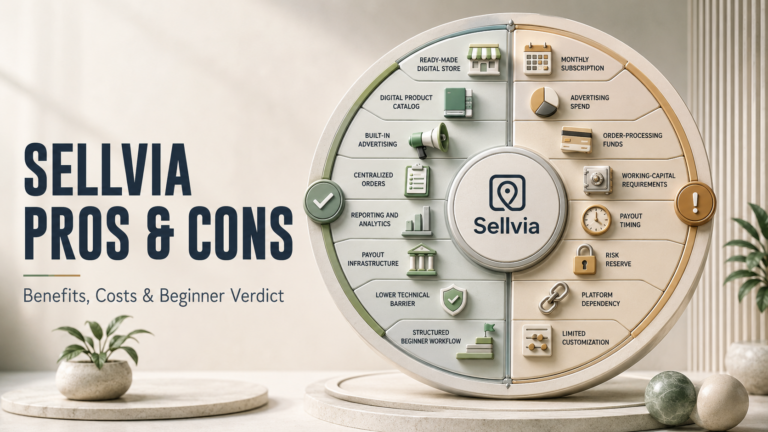
Neither approach is universally superior. The right choice depends on what the user already has and how much they value control versus convenience, which is why this comparison is best read alongside our full Sellvia review and our Sellvia pros and cons breakdown.
Final Verdict: Is Sellvia Worth It?
Sellvia can be worth the cost for the right beginner because it replaces a substantial amount of technical setup, store configuration, product preparation, software integration, advertising configuration, order organization, reporting fragmentation, and payout administration that would otherwise fall on the user’s shoulders.
Sellvia’s strongest value is not a promise of automatic profit. Its strongest value is the amount of infrastructure, setup work, and operational complexity it removes. It is most likely to be worth it when the user values convenience, wants a ready-made digital store, prefers digital products, has a realistic advertising budget, can fund order processing, understands payout timing, monitors unit economics rather than order count alone, and accepts the trade-offs of a managed-platform model. It is less worthwhile for someone with no operating capital, someone expecting guaranteed passive results, or someone who already owns a complete independent system and has no need to replace it.
Put simply: Sellvia is worth paying for when the time, tools, and complexity it replaces are more valuable to the user than the subscription, operating costs, cash-flow requirements, and reduced independence it introduces.
Readers who also want to verify the company’s legitimacy, operating history, and platform signals can review our separate analysis of whether Sellvia is legitimate.
This article provides an independent evaluation of Sellvia’s costs, operating model, and practical value. Platform pricing and policies may change, so readers should confirm current terms before making a financial decision.
Frequently Asked Questions
Is Sellvia worth it for beginners?
For many beginners with a realistic operating budget, Sellvia can provide meaningful value. It replaces a substantial amount of technical setup, product preparation, and software integration that would otherwise need to be handled independently. The value depends on having enough working capital for advertising and order processing, and on being willing to check performance rather than assume success automatically.
Is Sellvia worth $39 per month?
The subscription alone provides access to the store, catalog, advertising controls, order management, and reporting tools, but it is not the complete operating cost. Advertising, order-processing capital, and any applicable Performance Tier fee sit outside the $39 and should be budgeted separately before judging affordability.
What do you get with the Sellvia subscription?
Subscribers get access to a ready-made digital store, platform hosting, a digital product catalog, built-in advertising controls, order-management tools, reporting and analytics, balance tracking, and payout functionality where applicable. Continued access depends on keeping the subscription active.
Is advertising included with Sellvia?
The advertising system itself is built into the platform, but the ad spend is separate from the monthly subscription. Where currently applicable, budgets may start lower and increase in stages over the first several weeks, and users should confirm the current structure in their dashboard.
How much money do you need to start with Sellvia?
Beyond the $39 subscription, a new user should plan for a realistic advertising budget, a small order-processing buffer, and an emergency cushion for unexpected processing needs. There is no single universal number, since it depends on the user’s chosen budget and scaling pace.
Can Sellvia guarantee profit?
No platform can guarantee profit, and Sellvia does not promise specific sales, orders, or income. Outcomes depend on product selection, advertising performance, and how closely a user monitors cost per order against net commission.
How long does it take to withdraw money from Sellvia?
Recorded commission generally moves through Pending and Incoming stages before becoming Available for a payout request. Where currently applicable, Incoming may take approximately 72 hours, and a minimum withdrawal amount may apply. Current timing should always be confirmed in the dashboard.
What is the Sellvia Risk Reserve?
The Risk Reserve is a portion of eligible funds, reportedly around 25 percent, that may be held for a period before release, commonly cited as approximately 125 days, subject to disputes, refunds, and current platform terms. It functions as a standard safeguard for transaction stability rather than a permanent deduction.
Is Sellvia better than building your own store?
It depends on what the user already owns. Sellvia tends to offer stronger value for someone starting without an existing technical stack, while an independent setup may suit someone who already has the tools, products, and expertise and prefers full ownership over managed convenience.
Who may not find Sellvia worth it?
Users with no advertising budget, no capacity to fund order processing, a need for instant access to every dollar earned, or an existing complete independent business system are less likely to find the subscription worthwhile. These are practical mismatches rather than signs of an illegitimate platform.
One response to “Is Sellvia Worth It? A Practical Cost and Value Analysis”
-
What made Sellvia worth it for me was the amount of time it saved at the start. I didn’t have to build the store structure, search for digital products, or connect separate tools before I could begin testing. The platform still needs attention and a realistic budget, but having everything organized in one place made the whole process much less confusing.


Jeck Palmer is an ecommerce writer and platform researcher at Sellvia.info. He specializes in analyzing Sellvia’s features, pricing, tools, advertising system, order workflow, and overall business model. His articles are designed to explain complex platform processes in clear and practical language, helping beginners understand potential costs, evaluate available tools, and make more informed decisions before starting an online business.

Leave a Reply